
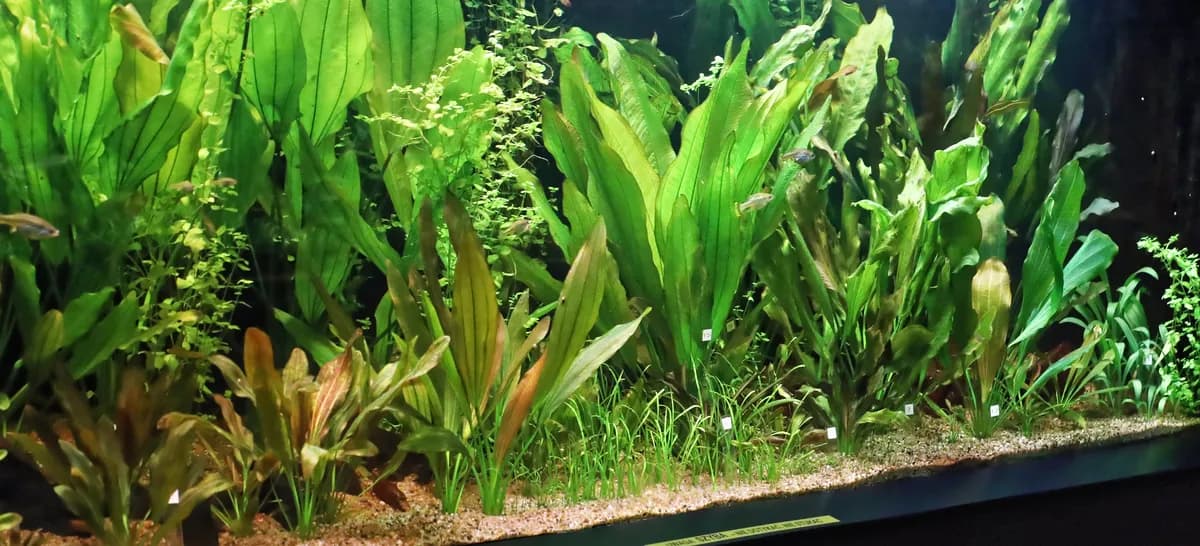
Photo: Burkhard Mücke · CC BY-SA 4.0

stocking · freshwater
Stocking a 75-gallon tank
A 75 is the same 48 inches long as a 55 but about 18 inches front to back, so the floor grows by about 40 percent. That depth is what lets a cichlid pair and a busy community share one tank. Three plans that pass the calculator, with fish counts, filter and heater sizes.
By Fishy Dave · Published 2026-11-01
Want ideas for a tank that is not 20 gallons? Try the stocking calculator. Same rules: adult size, waste, and a cycled tank.
Why a 75 instead of a 55
The 55 and the 75 look almost identical from across the room. Same 48-inch length, same 21-inch height. Walk up to the end of the tank and you see the difference: a 75 is about 18 inches front to back, five more than a 55.
Those five inches matter more than the 20 gallons. The floor grows from about 615 square inches to about 864. A pair of cichlids can claim one end and still leave the other end to everyone else. You can put driftwood and plants in front of each other, so fish can get out of sight without leaving the tank. Fish that would spend all day watching each other across a narrow 55 can settle into separate zones in a 75.
Each plan below clears the stocking calculator at 75 gallons with no warnings. Counting fish doesn't tell you much at this size. In the calculator, one adult angelfish makes about as much waste as 14 rummy-nose tetras.
Plan 1: Angelfish pair over a big rummy-nose school
Two angelfish, 20 rummy-nose tetras, 10 peppered cories, and one bristlenose pleco. Keep it at 76 to 78°F with soft to neutral water, sand, and tall Amazon swords or Vallisneria at the back.
The 21-inch height suits adult angels, and the depth gives a spawning pair room to guard one end without chasing the cories off the whole floor. Start with a bonded pair, or grow out four or five juveniles and rehome the extras once two pair off. Twenty rummies make a school big enough to move as one, which is the main reason to get a tank this size for them.
Four angels plus Plan 1's 20 rummies and cories goes over the calculator's waste limit. Angels are big, heavy eaters, and a pair leaves room for a full school.
Plan 2: Five Siamese algae eaters with barbs and loaches
Five Siamese algae eaters, 12 cherry barbs, 15 harlequin rasboras, 8 kuhli loaches, and a bristlenose pleco. Run it at 75 to 79°F and pH 6.5 to 7.0, or keep it at 75 to 78°F if you swap cories in for the kuhlis. This is a busy tank with something moving at every level.
A 55 holds three SAEs comfortably. A 75 holds five, and a larger group spreads out the chasing so no single fish takes all of it. They swim fast laps along the front, and the extra depth gives the other fish a back half of the tank to stay out of the way. Keep a tight lid on, since SAEs jump.
Cherry barbs and harlequins share the middle without much overlap, and the males of both color up better in a big group. Kuhlis need sand and stay hidden in the daytime. Feed sinking wafers after lights out so the SAEs don't get to them first. If you'd rather skip the kuhlis, 8 peppered cories in their place also passes.
Plan 3: A Bolivian ram group with pearl gouramis
Six Bolivian rams, three pearl gouramis (one male, two females), 15 cardinal tetras, and 8 peppered cories. Set the heater to 77 to 78°F, the narrow range where rams, pearls, cardinals, and cories all overlap. Keep the water soft to neutral and the flow gentle.
Six rams only works in a tank this size, and the reason is the floor. Rams live in the bottom few inches, and once two of them pair off, they claim a patch of sand around a flat stone. In a 75 there's room for a second patch at the other end with rockwork or wood in between. Expect some posturing at the border. That's normal. If one ram keeps getting chased into a corner, move it out.
Pearl gouramis take the top of the tank under floating plants, and the cardinals school in the middle. This plan is the calmest of the three, and it suits a planted tank with soft tap water.
What still doesn't fit
A single oscar passes the calculator in a 75, and its page treats 75 gallons as the minimum. But it passes on its own. Add even a bristlenose and the calculator flags the pairing, so plan the whole tank around the oscar.
A common pleco grows past a foot long and makes waste to match. Three fancy goldfish fit with nothing else, but they want cooler water than any plan here, and a fourth goes over the limit. Angelfish with neon tetras still gets a caution, since adult angels eat fish that small.
Weight, filter, heater, and stocking order
Water alone in a 75 weighs about 625 pounds, and with glass, sand, and rock a running tank goes past 800. Put it on a stand built for a 48 by 18 inch tank, not a dresser, and on a floor you trust. A tank that rocks on its stand needs shims before it gets water.
Use a filter rated for at least 75 gallons, like a Fluval 407 canister or an AquaClear 110, and about 300W of heat split between two heaters. Change 19 to 23 gallons a week. A gravel vacuum with a long hose that runs to a sink saves you a lot of bucket trips at this size. The water change guide has the rest.
Cycle the tank before any fish go in. Add the cories or kuhlis first, then the schools in two batches a couple of weeks apart, then the angels, SAEs, rams, or gouramis once ammonia and nitrite have stayed at zero. Quarantine each batch if you can. A 75 full of fish is a lot to lose to one sick arrival.
Filter and heater for a 75
A few listings we would open for this job. Skip anything you already own that still works.
Fluval 407 Performance Canister Filter
Rated for tanks up to 100 gallons, so a 75 sits comfortably inside its range. It holds enough foam and ceramic for the angelfish plan, which runs close to the waste limit.
Put the intake at one end and run the spray bar along the back. On an 18-inch-deep tank you can aim the return along the length so the far end gets flow too.
See this listingFluval AquaClear 110 Power Filter
The hang-on-back option, rated for about 60 to 110 gallons. It's simpler to service than a canister and the basket takes real media instead of a cartridge.
For plan 3, add a sponge over the intake and turn the flow down a notch. Rams and pearl gouramis don't want a current. On plan 2, the sponge also keeps kuhli loaches out of the intake.
See this listingAqueon Pro adjustable heater, 150W (buy two)
At 3 to 5 watts per gallon, a 75 in a 68 to 70°F room needs about 300W. Two 150W heaters at opposite ends heat a 4-foot tank evenly, and if one fails, the other keeps the water from dropping fast.
Same Pro line as the 29, 40, and 55 pages. Keep a thermometer in the middle of the tank, between the two heaters, and check it when you feed.
See this listing
Frequently asked questions
How many fish can go in a 75-gallon tank?+
It depends on the fish. An angelfish pair with 20 rummy-nose tetras, 10 peppered cories, and a bristlenose pleco fills most of a 75 by the calculator's math. Five Siamese algae eaters, 12 cherry barbs, 15 harlequin rasboras, 8 kuhli loaches, and a bristlenose is another full plan. Six Bolivian rams with three pearl gouramis, 15 cardinals, and 8 cories is a third.
What are the dimensions of a 75-gallon tank?+
About 48 inches long, 18 inches front to back, and 21 inches tall. The floor is about 864 square inches, compared with about 615 for a 55. Both tanks are the same length and height, so the extra 20 gallons all goes into depth.
Is a 75 better than a 55?+
For most community fish, yes. The 75 has the same length but five more inches front to back, which gives territorial fish like rams and angelfish room to stay out of each other's sight. It costs more and weighs more, so check that your stand and floor can take it before you buy.
Can an oscar live in a 75-gallon tank?+
One oscar can, on its own. The calculator passes a single oscar in a 75, but that uses most of the waste budget, and an oscar will eat anything small enough to fit in its mouth. Plan the tank around the oscar and nothing else.
What size heater and filter does a 75-gallon tank need?+
About 300W of heat, best split into two 150W heaters at opposite ends, and a filter rated for at least 75 gallons, such as a Fluval 407 canister or an AquaClear 110. Change 25 to 30 percent of the water weekly, which is about 19 to 23 gallons.