
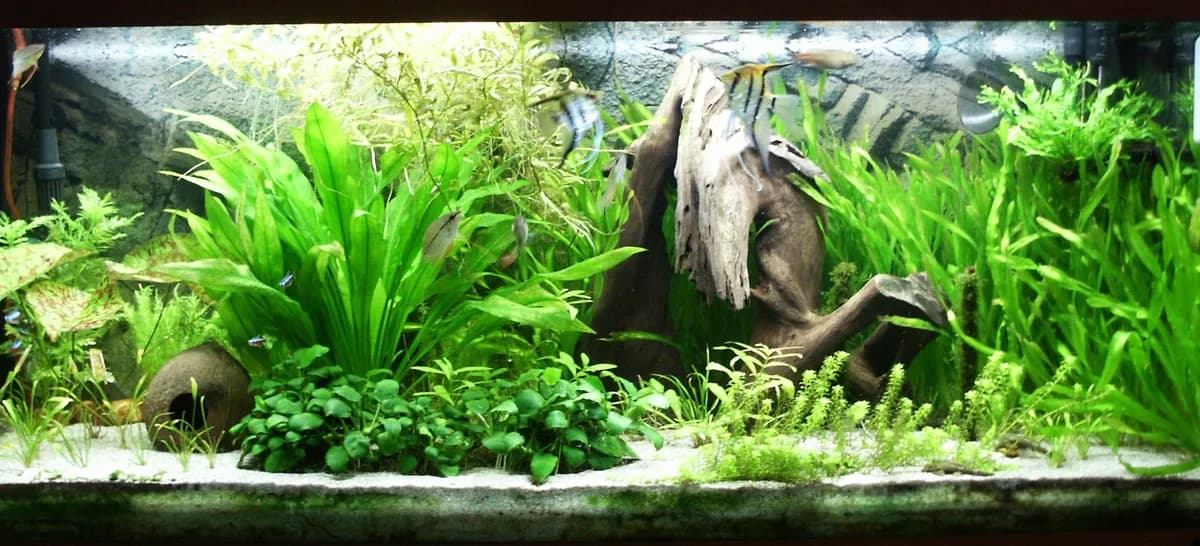
Photo: Matthias Kloszczyk · CC BY-SA 2.5

stocking · freshwater
Stocking a 55-gallon tank
A 55 is 48 inches long, about 13 inches front to back, and 21 inches tall. That height suits angelfish and the length suits fast swimmers, but the narrow floor leaves less room for fish that hold territory. Three plans that pass the calculator, with fish counts, filter and heater sizes.
By Fishy Dave · Published 2026-10-28
Want ideas for a tank that is not 20 gallons? Try the stocking calculator. Same rules: adult size, waste, and a cycled tank.
What the shape of a 55 changes
A 55 is where a lot of people land after a 29 or a 40 breeder. It looks huge in the store and normal once it's in the living room, which is the trick every bigger tank plays on you.
The numbers are about 48 by 13 by 21 inches. Next to a 40 breeder, you gain a foot of length and five inches of height, but you lose five inches of depth. That narrow front-to-back means a fish holding one corner can see every other fish in the tank. Cichlid pairs and gouramis that would settle into separate zones in a breeder have fewer places to get out of each other's sight. Tall plants and driftwood that break the tank up into left, middle, and right help more than a deep scape would.
The length is the good part. Fast schooling fish and Siamese algae eaters get four feet to swim, and the height suits angelfish, whose adult fins need more vertical room than a 40 breeder's 16 inches. Water alone weighs about 460 pounds, so put it on a stand made for a 55 and on a floor you trust.
Each plan below clears the stocking calculator at 55 gallons with no warnings.
Plan 1: Angelfish pair with rummy-nose tetras and cories
Two angelfish, 12 rummy-nose tetras, and 8 peppered cories. Keep it at 76 to 78°F. That is the bottom of the angels' range and the top of the cories'. Soft to neutral water, sand, and tall Amazon swords or Vallisneria for the angels to weave through.
Buy a pair that has already bonded, or start with four or five juveniles and rehome the extras once two pair off. Two unrelated adults dropped in together can fight. Rummy-nose tetras are big enough that grown angels leave them alone, and they school tightly in the middle of the tank.
This uses most of the waste budget. If you want a bristlenose pleco on the glass, drop to 10 rummies and 6 cories to make room. That version also passes the calculator, just barely.
Plan 2: Siamese algae eaters with two schools
Three Siamese algae eaters, 12 harlequin rasboras, 12 cardinal tetras, and 8 peppered cories. Run it at 75 to 78°F with soft to neutral water. This is the plan for a busy tank with lots of movement and no single centerpiece fish.
SAEs grow to about 6 inches and swim fast laps along the front glass, and that's where the 4-foot length earns its keep. A group of three spreads out any squabbling. Young ones graze black beard algae. Adults eat mostly fish food, so don't count on them to clean up a tank with too much light. Keep a tight lid on, because they jump.
Harlequins hang in the upper middle and cardinals stay lower, so the two schools don't crowd each other. If you'd rather have a bristlenose than the cardinals, three SAEs, 15 harlequins, 8 cories, and one bristlenose also passes.
Plan 3: Hard-water livebearers
Six common mollies, one male swordtail with three females, 6 platies, and a bristlenose pleco. This is the plan for hard, alkaline tap water with a pH around 7.5 to 7.8, and it runs at 74 to 78°F so the mollies stay comfortable without going past what the platies like.
On paper this uses about half the waste budget. That gap is for fry, which will arrive. Plants like hornwort and Java moss give the babies cover, and the adults will eat a fair share of them anyway. Decide early whether you'll raise extras in a second tank, ask your local fish store whether they take them, or keep only females.
Keep one male swordtail. In a 55 a second male spends his day sparring with the first, and the narrow tank gives the loser nowhere to go.
What doesn't fit in a 55
An oscar needs 75 gallons or more, and the calculator flags one in a 55 for both tank size and waste. A common pleco grows past a foot long. Two fancy goldfish fit on their own, but goldfish want cooler water than any tropical plan here, and a third goes over the waste limit.
Angelfish with neon tetras gets a caution. Adult angels can eat fish that small, which is why plan 1 uses rummy-nose tetras instead. Pairing angels with a Bolivian ram pair does fit under the waste limit, but two sets of cichlids guarding territory in a 13-inch-deep tank isn't a setup to try first.
Filter, heater, and stocking order
Use a filter rated for at least 55 gallons, such as a Fluval 407 canister or an AquaClear 70, and a 200W heater or two 100W heaters at opposite ends. Change 14 to 16 gallons a week. If nitrate climbs past about 20 ppm before the next change, lower it with bigger changes or fewer fish.
Cycle the tank before any fish go in. Add the cories first, then the schooling fish two or three weeks later, then the angels, SAEs, or male swordtail once ammonia and nitrite have stayed at zero. Quarantine each batch if you can. In a 55, one sick fish can take a lot of other fish down with it.
Filter and heater for a 55
A few listings we would open for this job. Skip anything you already own that still works.
Fluval 407 Performance Canister Filter
Rated for roughly 50 to 100 gallons, so a 55 sits at the low end of its range with room to spare. Plan 2 has three Siamese algae eaters that like moving water, and this gives them that without blasting the tetras.
Run the intake at one end and the spray bar along the back wall. On a 13-inch-deep tank the return can push everything toward the front glass, so angle it along the length instead.
See this listingFluval AquaClear 70 Power Filter
The hang-on-back option, rated for about 40 to 70 gallons. It hangs on the long back wall with room left for a heater and a light bracket, and the basket holds real foam and ceramic instead of a cartridge.
Listings switch between AquaClear 70 and Fluval 70 names. For the livebearer plan, cover the intake with a sponge so fry don't get pulled in.
See this listingAqueon Pro adjustable heater, 200W
At 3 to 5 watts per gallon, a 55 in a 68 to 70°F room needs about 200W. Same Pro line as the 29 and 40 pages: adjustable dial, shatterproof shell.
On a 4-foot tank, two 100W heaters at opposite ends keep the temperature even and leave you with one working heater if the other fails. Put a thermometer at the end away from the heater.
See this listing
Frequently asked questions
How many fish can go in a 55-gallon tank?+
It depends on which fish. An angelfish pair, 12 rummy-nose tetras, and 8 peppered cories fills most of a 55 by the calculator's math. Three Siamese algae eaters, 12 harlequin rasboras, 12 cardinal tetras, and 8 cories is another full plan. Small livebearers use less of the budget, but they breed, so leave the space for their fry.
What are the dimensions of a 55-gallon tank?+
About 48 inches long, 13 inches front to back, and 21 inches tall. The floor is about 615 square inches, a little less than a 40 breeder's 648. The extra volume comes from height, which helps tall fish like angelfish but not bottom dwellers.
Can I keep two angelfish in a 55?+
Yes. A bonded pair with a school of rummy-nose tetras and a group of cories fits, and the 21-inch height gives adult angels room for their fins. When a pair spawns, they will claim one end of the tank. Skip neon-sized tetras, since adult angels can eat them.
What size heater and filter does a 55-gallon tank need?+
A 200W heater, or two 100W heaters at opposite ends, and a filter rated for at least 55 gallons, such as a Fluval 407 canister or an AquaClear 70. Change 25 to 30 percent of the water weekly, which is 14 to 16 gallons.