
Freshwater · Beginner
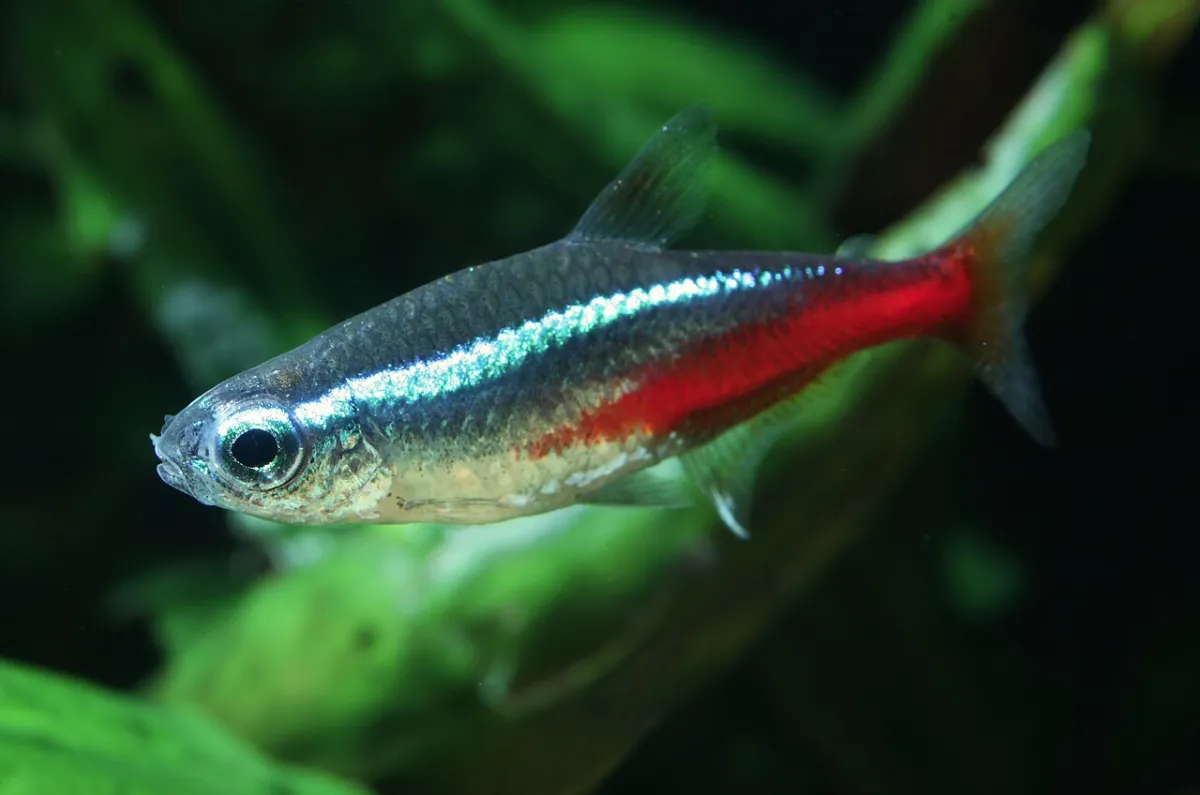
Neon tetra
Paracheirodon innesi
Neon tetras are small Amazonian schoolers that look their best in a planted 10-gallon (or larger) tank with a proper group, dimmer light, and stable, clean water.
Min. tank: 10 gal
Care notes →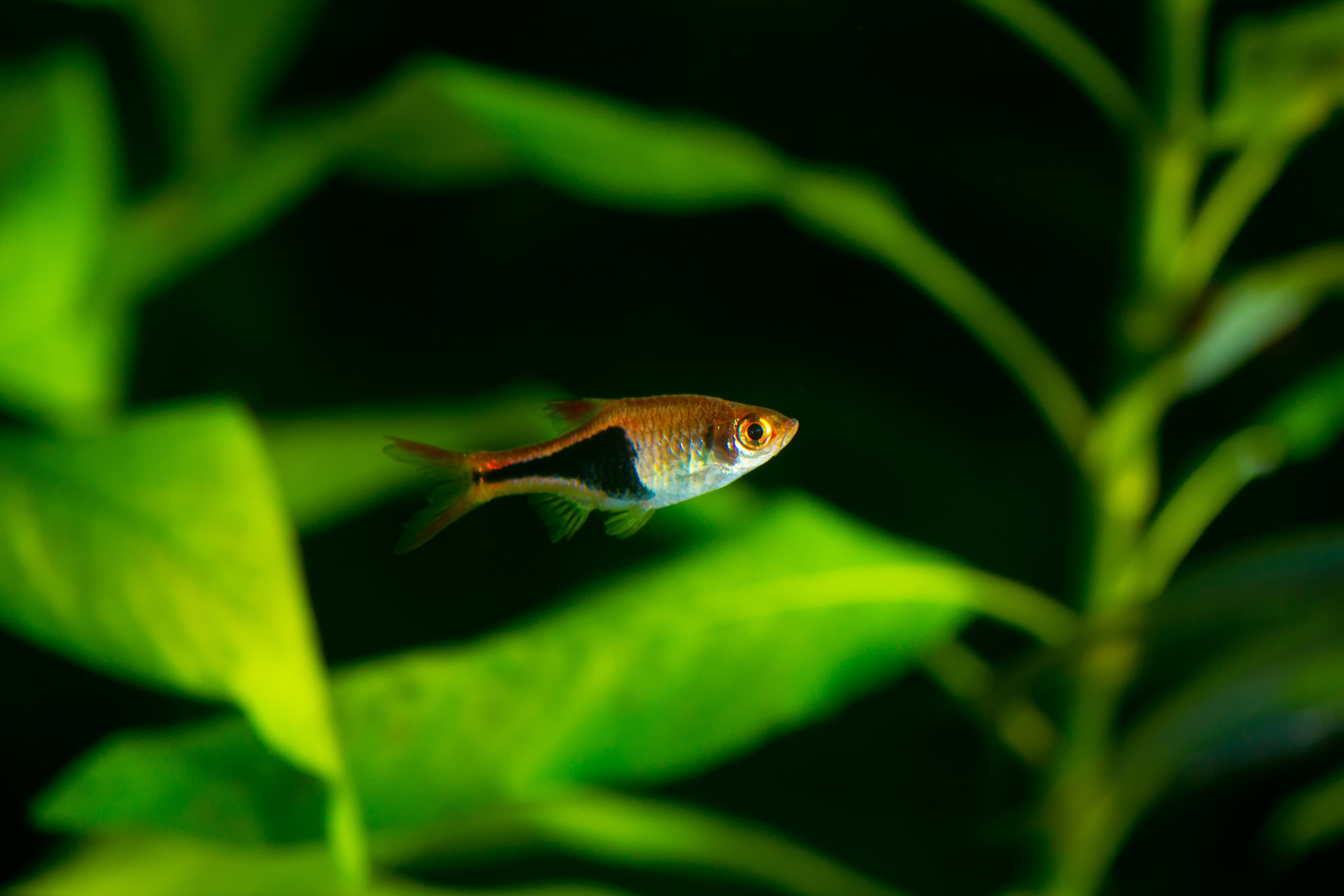
Photo: Mariusz Dabrowski · CC BY-SA 3.0
Freshwater · Beginner · 20+ gal
Trigonostigma heteromorpha
Harlequin rasboras (Trigonostigma heteromorpha) are peaceful midwater schoolers with a black triangle on the rear body. Plan six to ten in a planted 20-gallon; a 10 is a tight floor for six, not a comfortable home.
| Water type | Freshwater |
|---|---|
| Care level | Beginner |
| Minimum tank | 20 gallons |
| Temperament | Peaceful midwater schooler. Keep a real group of six to ten; pairs and trios look nervous and hide. Plant-safe and calm with other soft-water community fish. |
| Diet | Omnivore. Quality micro pellets or flakes sized for small mouths, plus frozen baby brine shrimp, daphnia, or finely chopped bloodworms a few times a week. Small portions twice daily. |
| Temperature | 72–81 °F |
| pH | 6–7.5 |
| Hardness / salinity | Soft to moderately soft water (roughly 2–12 dGH). They color up in slightly acidic to near-neutral water. Stable chemistry beats chasing a perfect number. |
Trigonostigma heteromorpha is a Southeast Asian cyprinid sold as the harlequin rasbora. The easy shop ID is the solid black triangle (or wedge) on the back half of the body, from the dorsal area down toward the caudal peduncle. Adults reach about 1.75 inches. Espei and lambchop rasboras are cousins with different markings; this page is about the classic harlequin, not those.
They are midwater fish. They cruise the middle third of a planted tank in a loose school, not glued to the glass and not rooting the substrate. Plants are safe. Bright bare tanks make them look washed out and shy.
Six to ten fish in a 20-gallon is the honest starting point. A 10-gallon can hold six if filtration and weekly water changes are tight, but it is a floor, not a recommendation. See stocking a 20-gallon tank for community layouts that leave swimming room.
A gentle hang-on-back or sponge filter is enough. Soften the outflow if they hug the plants. Dark substrate, stem plants, and a bit of cover help the triangle show. Weekly gravel vacuuming keeps mulm from building under the plants. Use the same tool covered on our aquarium gravel vacuum page, used with a 25–30% change (about 5–6 gallons from a 20).
Temps in the 72–81°F band and pH around 6.0–7.5 work for most shop fish. Soft water is preferred; hard alkaline livebearer tanks are a poor long-term match. Finish the cycle before you buy the school. Quarantine when you can.
Feed micro pellets or flake they finish in a minute, then add frozen a few times a week. Leftover food in a crowded 20 is how nitrate climbs. Tank mates that work: neons or cardinals if parameters overlap, a cory group on sand, a honey gourami later, cherry barbs in a planted 20, and adult cherry shrimp once nobody is still learning what a shrimp is. Skip tiger barbs, large cichlids, and anything that treats small midwater fish as snacks.
A few listings we would open for this species. Skip anything you already own that still works.
Hikari Tropical Micro Pellets, 0.77 oz
Harlequins have small mouths and a whole school to feed. These semi-floating micro pellets were made for tetras and other small schoolers; they sink slowly enough that the back of the group gets a shot.
A pinch twice a day, not a pile. Skip this if you already use a quality micro pellet they finish in a minute. Frozen baby brine a few times a week still helps.
See this listingAqueon Pro adjustable heater, 100W
A 20-gallon school wants stable mid-70s to low-80s F. The 100W Pro is the same size we open for other tropical 20s in a normal room.
Put a separate thermometer on the glass away from the heater. Skip stacking two heaters. Do not run them at the hot end just because a betta shares the stand.
See this listingFluval AquaClear 50 Power Filter
A 20-gallon school needs a hang-on-back you can stuff with extra sponge, not a sealed cartridge. Adjustable flow matters for midwater fish that hate being blasted.
Dial it down and baffle the outflow if they huddle in the plants. A seeded sponge filter as backup bio is fine. Confirm the 20-to-50 gallon AquaClear 50 listing.
See this listingA school of six to ten in a 20-gallon is a solid start. Fewer than six usually means shy fish that stick to the back glass.
Plan on 20 gallons for a real school. A 10-gallon is a tight floor for six, not a comfortable long-term home.
True harlequins (T. heteromorpha) show a solid black triangle on the rear body. Espei and lambchop cousins have different wedge and body patterns. Buy by scientific name when the bag label is vague.
Yes, if the tank is cycled, you keep a real school in 20 gallons, and you treat weekly water changes as normal. They are peaceful and plant-safe; the skill is group size and stable water, not exotic chemistry.
Freshwater · Beginner
Paracheirodon innesi
Neon tetras are small Amazonian schoolers that look their best in a planted 10-gallon (or larger) tank with a proper group, dimmer light, and stable, clean water.
Min. tank: 10 gal
Care notes →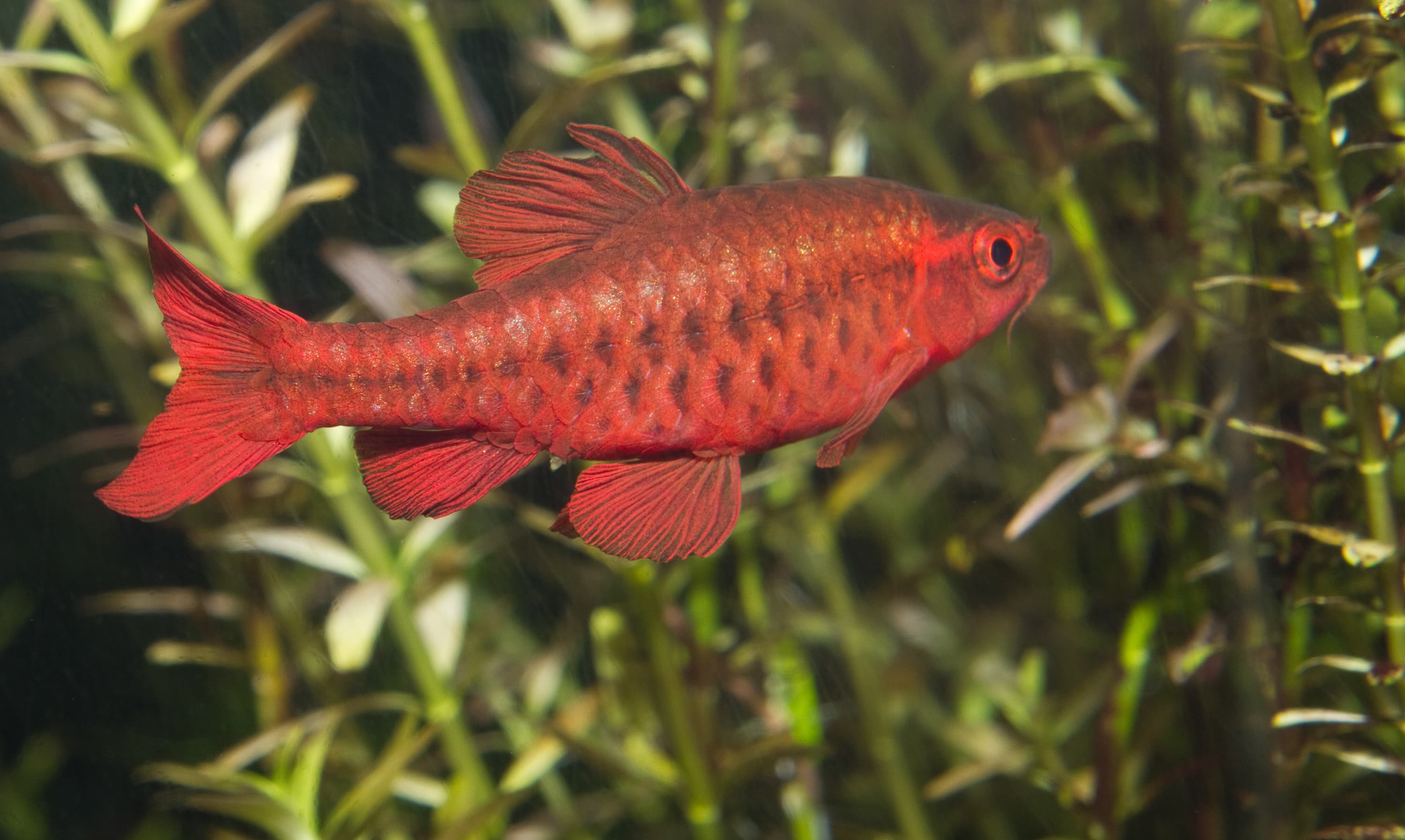
Freshwater · Beginner
Rohanella titteya
Cherry barbs (Rohanella titteya, still sold as Puntius titteya) are the peaceful Sri Lankan barb for a planted 20. Keep six or more so males color up deep red and any nipping stays in-group.
Min. tank: 20 gal
Care notes →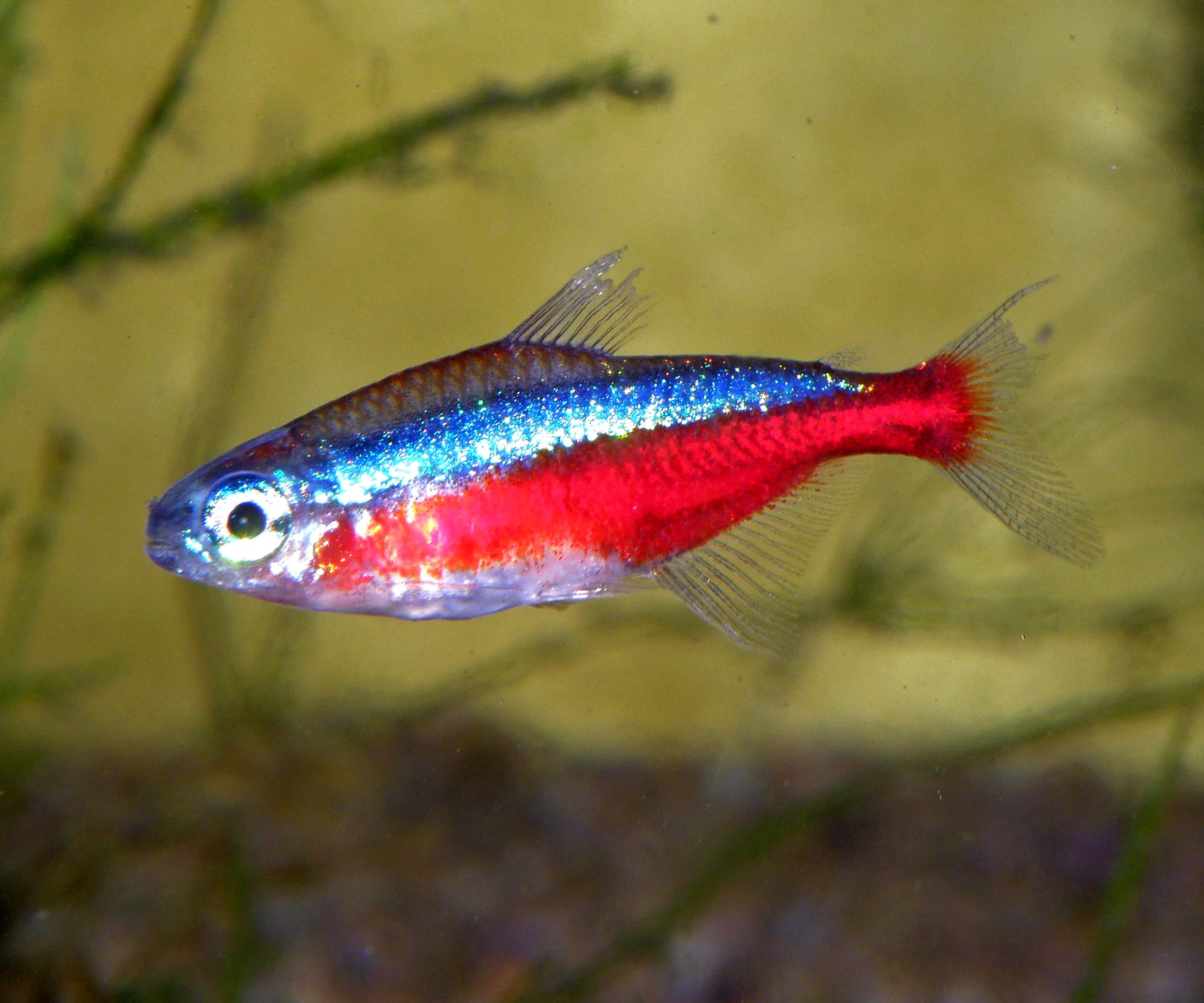
Freshwater · Intermediate
Paracheirodon axelrodi
Cardinal tetras (Paracheirodon axelrodi) are Amazon schoolers with a full red stripe from snout to tail. Plan a school of eight to ten in a planted 20-gallon with soft, clean water, not a neon-sized squeeze in a 10.
Min. tank: 20 gal
Care notes →