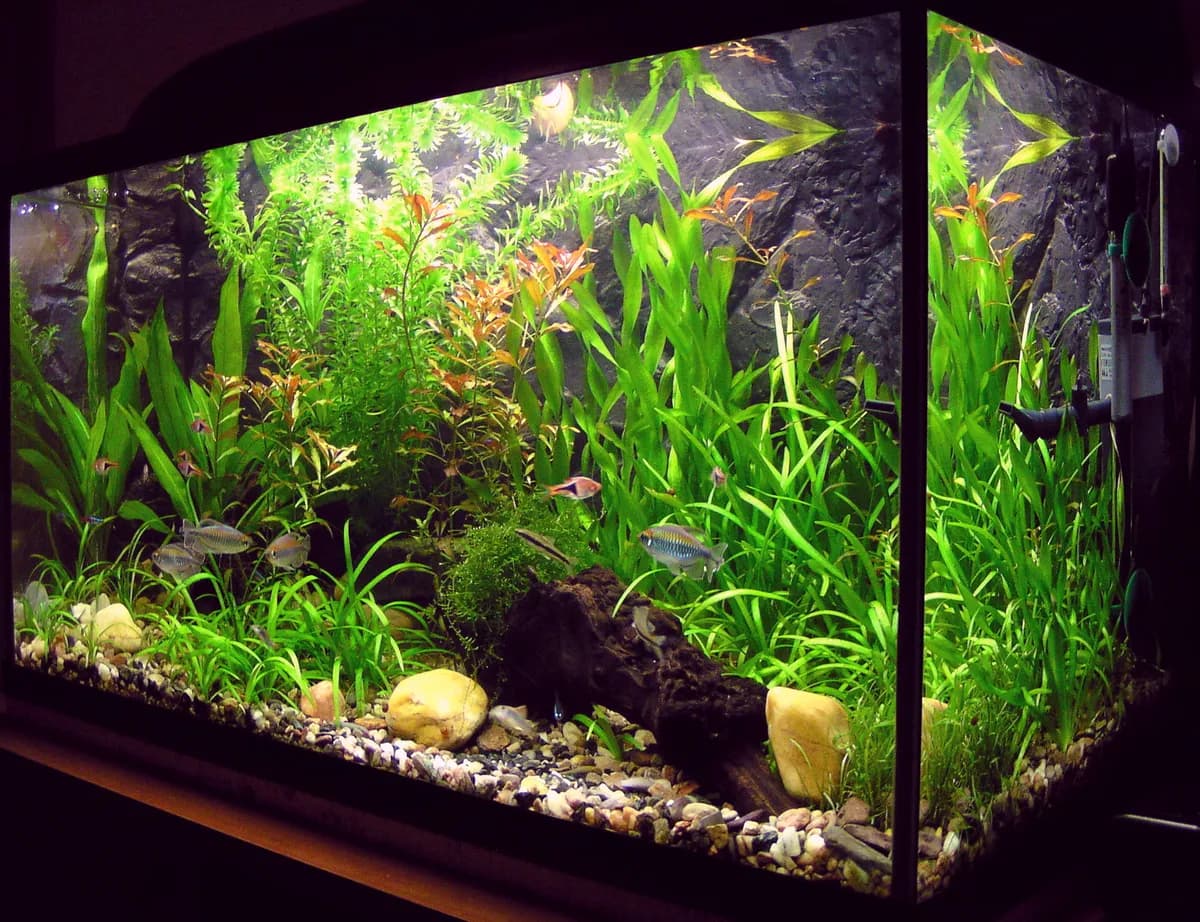
Photo: Aleš Tošovský · Public domain

husbandry
How to do a fish tank water change
A typical community tank wants 25–30% new water each week, gravel-vac'd and temperature-matched. Nitrates under about 20 ppm is the check, not a calendar.
Published 2026-09-01
How much, and how you know
A typical community aquarium does well with a 25–30% water change every week. In a 20-gallon tank that is 5–6 gallons out. Mark a line on the bucket or count jugs so you are not guessing when the siphon is running.
Messy fish change the math. Goldfish and oscars produce more waste than a school of tetras, so they often need larger or more frequent changes. A lightly stocked planted tank can sometimes stretch a few extra days. The check is nitrate staying under about 20 ppm between changes, not a date on the fridge.
Ammonia and nitrite should already read zero in a cycled tank. If they do not, that is a cycle or filter problem. Change water to protect the fish, then fix the cause. The cycling guide covers how you got here.
What you actually need
A gravel vacuum (a wide rigid tube plus a hose), a bucket that has never seen soap, and a dechlorinator that handles chlorine and chloramine. A thermometer for the new water. Towels. That is the kit.
The bucket is aquarium gear. Dish soap residue will kill fish. Write FISH on it. A $10–20 siphon and a five-gallon bucket cover a 20-gallon tank. You do not need a faucet-hookup hose system on day one.
Siphon, bucket, dechlorinator
Leave the fish in the tank. Scooping them into a mixing bowl is extra stress, a tiny ammonia trap, and a good way to drop someone on the floor.
Unplug the heater if the water line will fall below the heater's minimum mark. A heater that runs dry can crack. Leave the filter running if the intake will stay submerged; unplug it if it will suck air.
Set the bucket on the floor, lower than the tank. Submerge the wide end of the siphon, start the flow with the primer bulb or by filling the hose, and drop the hose into the bucket. Skip starting it with your mouth if you have a bulb. Work the wide tube into the gravel so waste lifts and gravel falls back. Cover the dirty patches. You do not have to vacuum every square inch every week. Stop when you have taken 5–6 gallons from a 20, or your planned percentage from a larger tank.
Dose dechlorinator in the new water at the rate on the bottle. Match temperature within a couple of degrees of the tank. Pour or hose it back slowly, onto a plate or against the glass so you do not blast the substrate into a cloud. Plug the heater back in. Confirm the filter is primed and the water line is back where it belongs.
What not to do
Do not drain the tank to the glass and bleach it. A 100% strip kills the bacteria you spent weeks growing and shocks the fish. Partial changes exist because the filter and the tank surfaces are the biofilter.
Do not rinse filter media under the tap. If the filter is clogged, squeeze the sponge or ceramic in a bucket of the old tank water you just siphoned. Tap chlorine and chloramine wipe those colonies.
Do not chase crystal-clear glass with a giant water change. Algae on the glass is a pad. The siphon is for dissolved waste and the mulm in the gravel.
Goldfish, oscars, and small betta tanks
Goldfish and oscars are wet pets. If nitrate will not stay down at 25% weekly, do more: twice a week, or 40–50% once a week, with a filter that is oversized. A 20-gallon is not a goldfish or oscar home; the water-change schedule is one more reason.
A betta in 5–10 gallons has less dilution. 25–40% weekly still applies. Skip a week and a small tank turns faster than a 20. Same siphon, smaller bucket, same dechlorinator.
Gear for water changes
A few listings we would open for this job. Skip anything you already own that still works.
Python No Spill Clean and Fill, 25 foot
Faucet-hookup gravel tube and hose. Drain and fill without buckets. The usual upgrade once you are tired of hauling 5 gallons across the kitchen.
Skip this on a 20 if a $15 siphon and a FISH-only bucket already work. Confirm the brass adapter fits your faucet. 25 feet covers a kitchen-to-stand run; 50 is for the basement tank.
See this listingSeachem Prime, 500 ml
Concentrated dechlorinator that handles chlorine and chloramine. Dose the new water, not the whole tank. A 500 ml bottle lasts a long stretch of weekly 25% changes.
Skip a second bottle if you already use a chloramine-capable conditioner. The sulfur smell is normal. This is not a substitute for water changes.
See this listingAPI Freshwater Master Test Kit
Nitrate under about 20 ppm is how you know the weekly 25–30% is enough. Liquid reagents for ammonia, nitrite, nitrate, and pH. Same kit as the gear page.
Freshwater only. Skip strips as your only tool. If the bottles you already own are in date, you do not need another kit.
See this listing
Frequently asked questions
How often should I change aquarium water?+
Weekly is the baseline for a typical community: 25–30%. Messy fish (goldfish, oscars) need more. A lightly stocked planted tank can sometimes wait, but if nitrate is over about 20 ppm, change water. The test kit beats a calendar.
Do I take the fish out for a water change?+
No. Leave them in the tank. Moving fish into a bucket is extra stress and a good way to injure them. Work around them with the siphon.
Can I change 100% of the water?+
Do not. A full drain-and-scrub wipes the bacteria on the glass and in the gravel, swings temperature and chemistry, and is not a deep clean. Partial changes exist on purpose.
Should I rinse the filter when I change water?+
Only if flow is actually clogged. Squeeze media in the old tank water you just siphoned. Never rinse it under the tap. Chlorine and chloramine kill the bacteria that live there.