
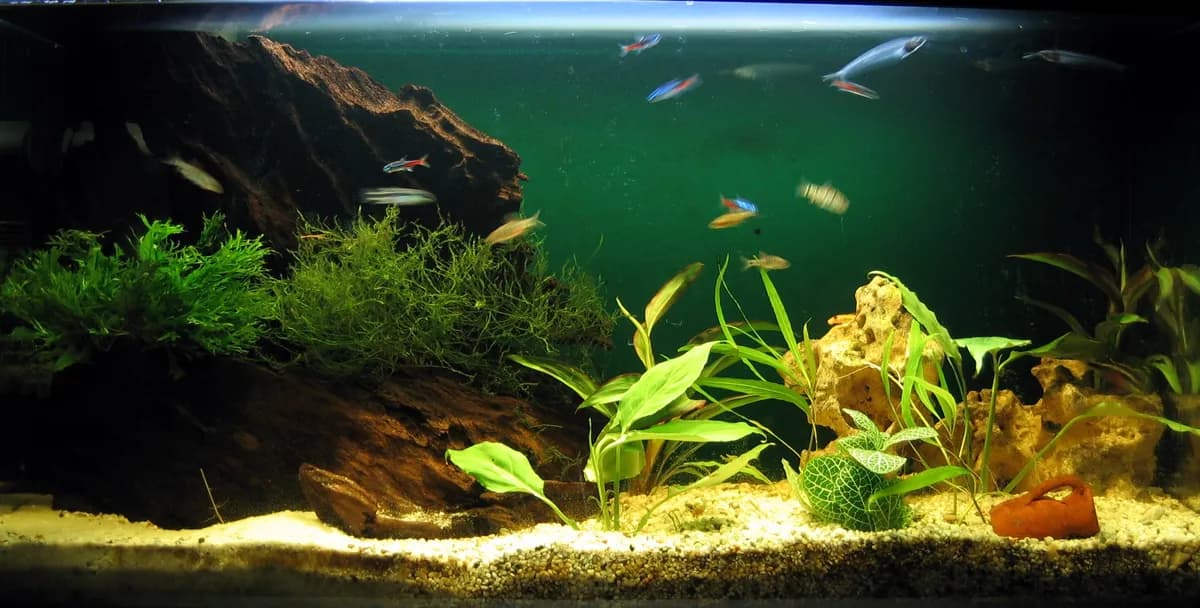
Photo: Richardfabi · CC BY-SA 3.0

Gear
Aquarium lid for jumpers and evaporation
By Fishy Dave
A fitted lid stops jumpers, cuts evaporation, and keeps cats and curious hands out. Measure the rim opening, leave room for the HOB lip and cords, and pick glass for most freshwater or mesh when a saltwater nano needs more gas exchange.
A lid has three jobs: keep jumpers in, slow evaporation, and keep cats and curious hands out. Firefish, guppies, Siamese algae eaters, kuhli loaches, and nerite snails all leave the water when a corner gap is open. Saltwater tanks also lose volume fast under bright lights and dry air. Fit the lid to the rim opening, not the gallon label on the box.
Measure the rim, then plan the cutouts
Measure length and width of the inside opening to the nearest millimeter. Brands that sell a 10-gallon or a 20-long do not share one opening size. Write down where the hang-on-back filter sits, and where the heater cord and airline need a path.
Most glass canopies ship with a clear plastic back strip you trim with scissors or a knife. Leave the strip snug around the HOB lip so there is no fish-sized escape hole. Do not seal cords so tight that you pinch the insulation.
Glass for most freshwater, mesh when air matters
A tempered glass canopy or hinged glass top is the default on rimmed freshwater 10s and 20s. It cuts evaporation, gives a flat place for a clip-on light, and keeps community fish inside. Expect condensation on the underside. Wipe it when you wipe the front glass if droplets block the light.
Mesh or screen lids suit many saltwater nanos and open-top reefs. They let more air and light through while still stopping jumpers. You will top off more often than under glass, so keep a salinity check in the routine. See the beginner saltwater setup guide for the rest of that stack.
Kit hoods, rimless tanks, and DIY acrylic
Starter kits often ship with a plastic hood and a built-in light. Keep that hood if it still covers the tank and the hinge works. Replace it when the plastic warps, yellows, or leaves a gap jumpers find. A glass canopy with a trim strip is the usual next step on a framed 10 or 20-long.
Rimless tanks and DIY acrylic tops are a different fit problem. Off-the-shelf glass canopies assume a rim ledge. For rimless, use a cut-to-fit mesh kit, a brand-specific screen, or a short run of polycarbonate cut to the outside edge. Skip a custom fab rabbit hole unless you already have the tools and a template.
What to buy
The picks below are a glass canopy sized for many common 10-gallon rims, a larger glass canopy for many 20-long and 29-gallon rims, and a magnetic mesh kit you cut for jump-prone saltwater nanos. Two of the three is enough for most homes. We may earn a commission if you buy. See the affiliate disclosure.
What we would buy
H2Pro 20-inch glass canopy for 10-gallon tanks
Tempered glass sized for many standard 10-gallon rim openings (about 19.33 x 9.65 inches). Clear plastic back strip you trim for the HOB and cords. Stops jumpers and slows evaporation on a common beginner tank.
Measure your rim before you buy. H2Pro lists fit for many Aqueon-style 10s; Imagitarium, Top Fin, and other brands can differ by a few millimeters. Cut the back strip once, carefully. Skip this size if your opening is closer to a 20-long footprint.
See this listingH2Pro 30-inch glass canopy for 20-long / 29-gallon tanks
Same tempered glass idea in the common 29.21 x 11.69 inch size that fits many Aqueon, Marineland, and Perfecto 20-long and 29-gallon rims. Useful when the starter kit hood is cracked or missing.
Does not fit every brand. Top Fin, Imagitarium, Deep Blue, and some Seapora tops need their own canopy. Measure the opening. Trim the back strip for the filter lip and any heater cord.
See this listingMagnetic mesh aquarium lid kit (cut-to-fit)
Screen-style net with magnetic strips and a feeding window. Better gas exchange than a sealed glass top on a jump-prone saltwater nano, while still stopping firefish and other surface jumpers. Cut the mesh to your rim.
Kits list a max footprint (often around 39 x 19 inches or larger). Cut down for a nano; do not stretch a short kit across a 40. Mesh cuts evaporation less than glass, so top off saltwater more often and watch salinity. Rimless DIY acrylic is a different fit problem; a cut-to-fit mesh or a purpose screen kit is usually simpler than custom fab glass. Specific kits go in and out of stock; search picks a current cut-to-fit magnetic mesh set.
See this listing
Frequently asked questions
How do I measure for an aquarium lid?+
Measure the inside opening of the rim, length and width, to the nearest millimeter. Do not trust the gallon sticker alone. Different brands with the same gallon label cut the top differently. Note where the HOB hangs, and where the heater cord and airline need to pass.
Glass canopy or mesh lid?+
Glass or a hinged glass top suits most freshwater community tanks. It cuts evaporation and keeps guppies, kuhlis, and nerites from touring the carpet. Mesh or a screen top suits many saltwater nanos and rimless reefs where you want more air exchange and light through the top, while still stopping firefish and other jumpers.
What about condensation and cutouts?+
Glass tops collect condensation. Wipe the underside when you clean the glass if droplets fog the light. Trim the plastic back strip (or cut mesh) so the HOB lip, heater cord, and airline sit flat without a fish-sized gap at the corner.
My kit came with a flimsy plastic hood. Replace it?+
Keep it if it still covers the opening, the light works, and fish stay in. Replace it when the plastic warps, the hinge cracks, or jumpers slip past a gap. A tempered glass canopy with a trim-to-fit back strip is the usual upgrade on a rimmed 10 or 20.