
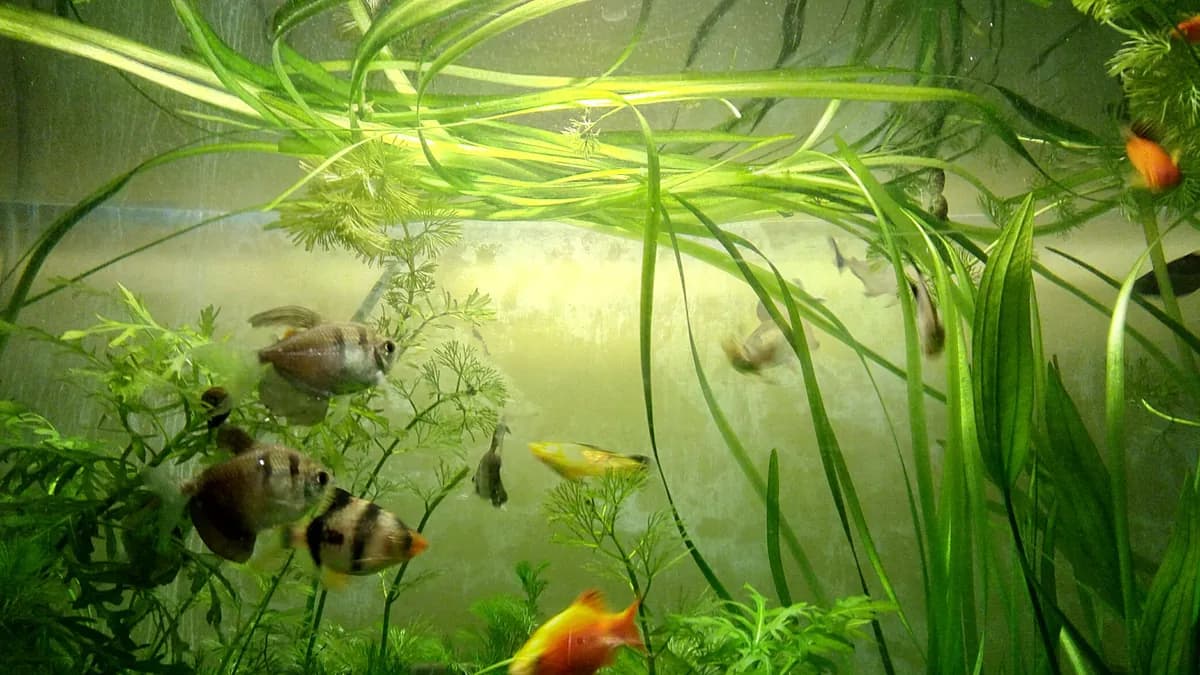
Photo: Damitr · CC BY-SA 4.0

stocking · freshwater
Stocking a 29-gallon tank
A 29 is the next honest step after a 20. Inch-per-gallon is still a myth. Pick one community plan: honey gourami centerpiece, hard-water livebearers, or a single adult bristlenose with a midwater school.
By Fishy Dave · Published 2026-09-25
Want ideas for a tank that is not 20 gallons? Try the stocking calculator. Same rules: adult size, waste, and a cycled tank.
Why a 29 is its own size class
A standard 29-gallon is roughly 30 by 12 by 18 inches. That height helps honey gouramis and tall plant stems. The footprint is only a little longer than a 20-long, so it is not a free pass to dump twice the livestock.
Throw away inch-per-gallon once. Then pick one lane: a peaceful planted community, a hard-water livebearer tank, or a single adult bristlenose with a midwater school. When in doubt, stock less. Our 20-gallon and 10-gallon stocking guides cover the smaller kit sizes; the stocking calculator can sanity-check adult size against this volume.
Three setups that actually fit
Honey gourami community: one honey gourami (or a calm pair in a planted layout) with a school of 8-10 harlequin rasboras or 10+ ember tetras, plus 6 peppered cories on sand. Soft-to-moderate water, gentle flow, plants. Skip male bettas and nippy barbs in the same glass.
Hard-water livebearer 29: a mixed platy group, or one male swordtail with several females, in alkaline hard water with plants and weekly water changes. Mixed sexes mean fry. Do not add neon or cardinal tetras to chase color; those fish want softer water. See the GH/KH guide if your tap fights one of those plans.
Bristlenose plus school: one adult Ancistrus with driftwood and sinking veg wafers, plus a peaceful midwater school such as 8-12 harlequins or a similar count of neon tetras if the water matches. A 29 is the comfortable home for an adult bristlenose; a long 20 is the floor, not a pair tank. They still make a lot of waste.
What does not belong in a 29
Common or unlabeled chain-store plecos that reach 18-24 inches, oscars, yellow tangs, and other livestock that outgrow or out-pollute this box. Goldfish commons belong in much larger tanks or ponds. A pair of angelfish can work in a tall 29 if you keep the rest of the stock sparse and watch territory; stacking angels plus a busy community is how you get shredded fins.
One of each species is worse than a proper single plan. Twelve different beginner fish in a 29 will fight for space and foul the water. The stocking calculator will not invent filtration for a crowded display.
Filtration, heat, and stocking order
Plan a heater near 100W for most tropical 29s in a normal room, an AquaClear 50-class hang-on-back or a Fluval 207-class canister, and weekly 25-30% water changes. About 7-9 gallons out is the usual siphon from a full 29. Test. If nitrate climbs past about 20 ppm between changes, change more water or stock less.
Cycle first. Add the school or the bottom dwellers, wait, test, then add the centerpiece only if ammonia and nitrite stay at zero. Leave headroom for growth and for a missed week of maintenance. The water-change, heater, hang-on-back, and canister pages cover the hardware details.
Hardware that matches a real 29
A few listings we would open for this job. Skip anything you already own that still works.
AquaClear 50 Power Filter
Hang-on-back rated for about 20-50 gallons with a media basket big enough for foam and ceramic. A tall 29 with a community bioload wants this class of HOB, not the tiny cartridge that came in a 10-gallon kit.
Prime the box with tank water on first start. Dial flow if long-fin fish get pinned. Carbon is optional once the tank is established. Skip this if you already run a Fluval 207-class canister on the same tank.
See this listingFluval 207 Performance Canister Filter
The usual external filter class for a planted 29-40. More media volume than a rim HOB, quieter return options, and room to stack coarse foam then ceramic without weekly cartridge shopping.
Prime after every open. Not required if an AquaClear 50 already keeps ammonia and nitrite at zero. Skip for a lightly stocked 10. See the canister filter page for media order and maintenance.
See this listingAqueon Pro adjustable heater, 100W
Most tropical 29s in a ~70°F room land near 3-5 W per gallon, so 100W is the common starting size. Same Pro line used on the heater gear page for 20s; a cold basement may want the next wattage up.
Trust a separate thermometer on the glass, not the dial alone. Do not stack two heaters that fight each other. Unplug before a big water change if the water line will drop past the heater minimum mark.
See this listing
Frequently asked questions
How many fish can I put in a 29-gallon tank?+
There is no single number. A honey gourami with a school of harlequins or embers plus a group of peppered cories is one honest plan. A mixed livebearer group in hard water is another. An oscar or a common pleco is not.
Is a 29-gallon better than a 20?+
Usually yes for adult bristlenose, swordtail groups, and taller midwater fish. A standard 29 is about 30 inches long and 18 inches tall, so you get height a 20-long lacks. A 20-long still wins for frantic horizontal swimmers if that is all you keep.
Can I keep an oscar in a 29-gallon?+
No. Oscars need far more volume as adults, often 75 gallons and up. A 29 is a temporary grow-out at best and a bad plan as a permanent home. See the oscar page.
Is inch-per-gallon accurate for a 29?+
No. Twenty-nine one-inch juveniles are not a stocking plan. Adult size, waste, schooling needs, and how often you will change water matter more than adding inches.