
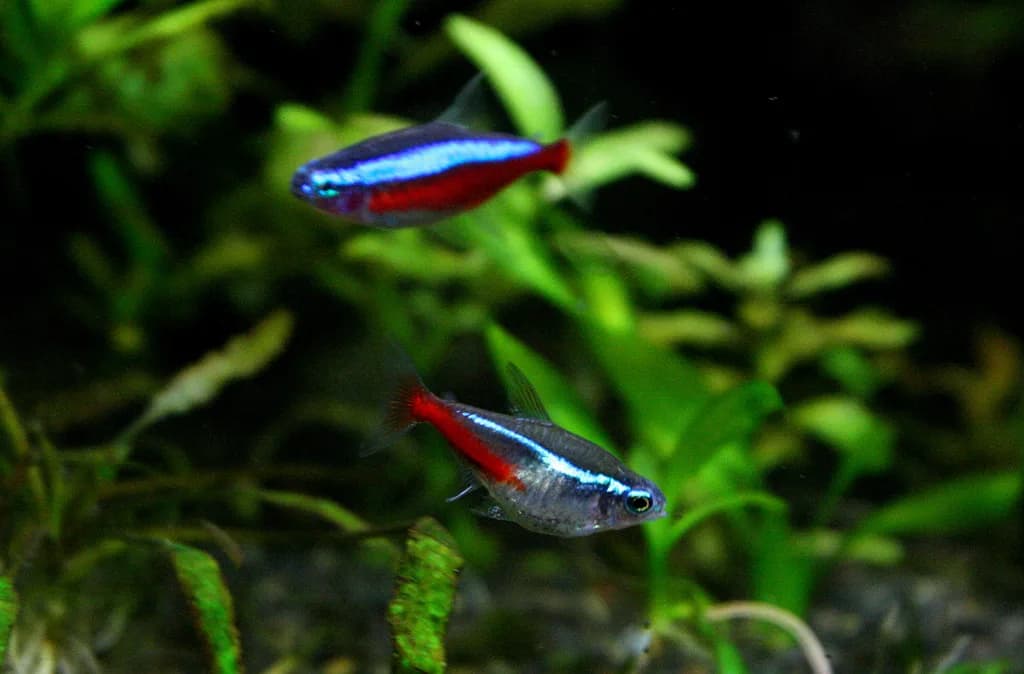
Photo: úlfhams_víkingur · CC BY 2.0

stocking · freshwater
Neon tetra vs cardinal tetra
Check the belly. On a cardinal tetra the red runs from the head to the tail. On a neon it covers only the back half. Cardinals also grow a little bigger, want warmer and softer water, need a 20-gallon for their school, and are mostly wild-caught. Neons are farm-bred, cheaper, and fine in a cooler 10 or 20.
By Fishy Dave · Published 2026-10-21
Want ideas for a tank that is not 20 gallons? Try the stocking calculator. Same rules: adult size, waste, and a cycled tank.
Look at the belly. If the red runs from just behind the head all the way to the tail, it is a cardinal tetra. If the front half of the belly is silver-white and the red only starts around the middle, it is a neon. The blue stripe on top is nearly the same on both, which is why shop tanks get them mixed up.
I once paid cardinal money for a bag of what turned out to be neons in good lighting. Since then I look at the belly before I look at the price tag. Once they are home, the differences that matter are water temperature, hardness, and how many fish your tank can hold.
Side by side
These are the same numbers the neon tetra and cardinal tetra care pages use. They share a genus and most of a pH range, so the real gaps are temperature, tank size, and where the fish came from.
| Neon tetra | Cardinal tetra | |
|---|---|---|
| Scientific name | Paracheirodon innesi | Paracheirodon axelrodi |
| Red stripe | Rear half of the body | Full length of the belly |
| Adult size | Under 1.5 in | About 1.5 to 2 in |
| Temperature | 72 to 78°F | 73 to 80°F |
| pH | 5.5 to 7.0 | 5.5 to 7.0 |
| Hardness | About 1 to 10 dGH | About 1 to 8 dGH |
| Smallest tank | 10 gal for six | 20 gal for eight to ten |
| School | 6 minimum, 8 to 12 in a 20 | 8 to 10 in a 20 |
| Source | Farm-bred | Mostly wild-caught |
| Care level | Beginner | Intermediate |
Telling them apart in the shop
Check the belly from the side, not from above. Under bright shop lights a stressed neon's colors wash out and a cardinal's red can look short if the fish is turned toward you. Wait until one swims broadside past the glass.
Size helps with adults. A grown cardinal is a little longer and deeper in the body than a grown neon. Young fish in a shop are often the same size, so do not rely on it there. Labels help least of all. Ask to see the tank they came in from, or check the invoice name, before you pay the higher price.
Two other fish get sold next to them. The green neon (Paracheirodon simulans) is smaller, with a wider blue stripe and very little red. The black neon tetra is a different genus with a white-over-black stripe and no red at all. Both are good fish, but neither one is a neon or a cardinal.
Wild-caught cardinals and the first two weeks
Neons have been farmed in huge numbers for decades. They arrive used to tank water and tap-water hardness, and they cost less. Cardinals are still mostly caught in the Rio Negro and its tributaries in Brazil, then held, bagged, and flown out. Fish that survive that trip usually settle well, but the losses cluster in the first week or two.
So buy cardinals for a tank that has been cycled for at least a month, not one that just finished. If you can, quarantine them for two to four weeks and feed small meals of micro pellets and frozen baby brine. Pick a shop whose cardinals have been in its tanks for a week or more and are eating. Neons can carry neon tetra disease and need the same quarantine, but a farmed batch usually handles the move better.
Temperature and water
Neons do best in the mid-70s and should not live at the hot end of tropical. Cardinals tolerate 73°F but color up and eat better from about 76 to 80°F. Both overlap at roughly 73 to 78°F, so a community tank set to 76°F suits either.
Both want soft, slightly acidic to neutral water. Neons adapt to moderate tap hardness if you change it slowly. Cardinals are less forgiving of hard, alkaline water and of nitrate creeping up between water changes. If your tap reads high on GH, the GH, KH, and pH guide explains what the numbers mean. Neons are the easier pick in that case.
That temperature gap also decides tank mates. Cardinals fit a warmer tank with rummy-nose tetras, kuhli loaches, or a pearl gourami, and they are the usual dither school for a dwarf cichlid like a Bolivian ram. Neons fit a cooler community with peppered cories, pygmy cories, or zebra danios at the low end of the range.
Stocking a 20-gallon with either
A 20-gallon fits either school. For neons, ten fish plus six peppered cories on sand is a full, calm tank. For cardinals, eight fish plus six cories is the same idea with the cardinal's bigger body and warmer water. Set the heater to about 76°F if cories share the tank, since peppered cories top out at 78°F. The 20-gallon stocking guide has other plans.
A 10-gallon is neon territory only. Six neons with a gentle filter and weekly water changes work. Cardinals need the larger school and steadier water of a 20.
Run your list through the stocking calculator before you buy. It uses the same school sizes and counts a cardinal as a slightly bigger fish than a neon.
Keeping both in one tank
Neons and cardinals do not fight, and at 76°F both are comfortable. They also do not school together. In a mixed tank each species drifts around in its own loose group, so six neons and two cardinals gives you two shy cardinals rather than a school of eight.
If you want both, keep at least six of each in 29 gallons or more. In a 20, eight of each plus six cories goes over the stocking calculator's waste limit. For most 20-gallon tanks, one species in a bigger school looks better than two small groups.
Frequently asked questions
What is the difference between a neon tetra and a cardinal tetra?+
The red stripe. On a cardinal tetra (Paracheirodon axelrodi) it runs the whole length of the lower body, from under the eye to the tail. On a neon tetra (Paracheirodon innesi) it starts around mid-body and runs back to the tail, with silver-white belly in front. Cardinals also grow a bit larger, about 1.5 to 2 inches against a neon's 1.5, and like warmer, softer water.
Can neon and cardinal tetras live together?+
Yes. They are both peaceful and their temperature ranges overlap at about 73 to 78°F. They will not merge into one school, though. Each species keeps loosely to its own kind, so you need six or more of each, and that is a lot of fish for a 20-gallon that also has cories.
Are cardinal tetras harder to keep than neon tetras?+
A little. Most cardinals are wild-caught and arrive stressed from shipping, so the first two weeks are where you lose them. Once settled they are steady fish in a cycled tank with soft water and low nitrate. Neons are farm-bred and used to aquarium water, which is why neons are the easier first school.
How many neon or cardinal tetras can go in a 20 gallon tank?+
Eight to twelve neons, or eight to ten cardinals, as the main school. With six peppered cories on the bottom, plan about ten neons or eight cardinals. The stocking calculator runs the same numbers for your tank size.
Can cardinal tetras live in a 10 gallon tank?+
Not as a real school. A 10-gallon holds six neons if filtration and water changes are solid, but cardinals want eight or more and stable soft water, which is a 20-gallon job.
Why are cardinal tetras more expensive?+
Most are collected wild in the Rio Negro basin in Brazil and flown out, and more die along the way than farmed neons do. Captive-bred cardinals exist but are less common. In most shops a cardinal costs roughly twice what a neon does.