
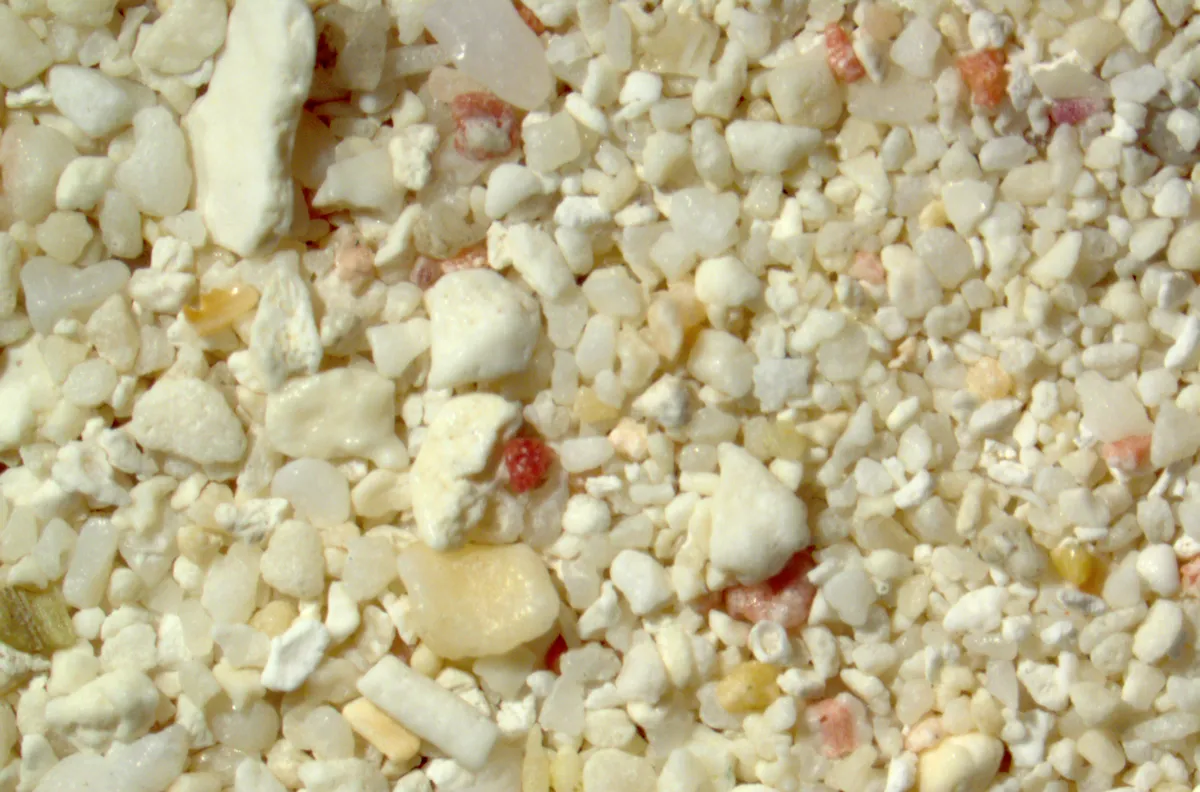
Photo: Wilson44691 · Public domain

Gear
Crushed coral and GH booster
By Fishy Dave
Test GH and KH before you buy anything. Crushed coral in the filter raises both slowly on soft tap water. A GH remineralizer rebuilds RO or rainwater, and a KH buffer stops pH crashes. Dose from the label, raise the numbers over days, and test again a week later.
If your livebearers sulk, your snail shells look pitted, or pH falls apart every few weeks, the water may be too soft for what you keep. This page covers the three things worth buying to fix it, and when to buy none of them.
Test first. If your tap already comes out hard, close this tab and spend the money on fish food.
Find out whether GH or KH is low
GH is the calcium and magnesium that fish, shrimp, and snails use, and KH is the carbonate buffer that keeps pH from swinging. The GH, KH, and pH guide explains both in more detail.
Run a GH and KH liquid test on the tank and on a glass of tap water before you buy anything. Strips give a rough idea, and drops give a number you can act on. The water test kit page covers what to get. Low GH and low KH together on tap water points to crushed coral. Low GH on RO water points to a remineralizer. Low KH with a crashing pH points to a buffer.
Crushed coral in the filter or the gravel
Crushed coral is aragonite, a form of calcium carbonate. In soft water it slowly dissolves and adds calcium and carbonate, which raises GH and KH and nudges pH up. As the water hardens it dissolves more slowly, so a sensible amount levels off instead of climbing forever.
The easy way to use it is a mesh bag where water flows through it. In a hang-on-back filter that means behind the cartridge. In a canister it goes in a media tray. You can also mix it into the gravel when you set up a tank, but it is hard to take back out later.
Biofilm coats the coral over time and slows it down. When your readings start to slide, rinse the bag in old tank water and top it up.
A GH booster for RO water and rainwater
Reverse osmosis water, distilled water, and rainwater have almost no minerals and no buffer. A remineralizer puts back the calcium and magnesium. Mix it into new water before each water change, using the dose on the label, and mix every batch to the same GH reading so the tank doesn't swing.
Top off evaporation with plain RO water, or tap water if that is what you change with, and never dose the top-off. Minerals stay behind when water evaporates, so dosing top-off water raises GH a little more every week.
A KH buffer when pH keeps crashing
If KH reads 1 or 2 and pH drops between water changes, the tank has run out of buffer. Fish and filter bacteria both make acid, and with no carbonate left to soak it up, pH falls. A KH buffer adds carbonate back. Crushed coral does the same job more slowly, so many people use a buffer for the first week or two and then let the coral take over.
Raise it slowly and test before and after
Raise GH or KH by no more than about 2 degrees a day. Fish handle a climb spread over a week much better than a jump in one afternoon. Test before you add anything, test the next day, and test again a week later before you add more.
Don't chase a pH number. If GH and KH are right for your fish, pH will settle where it settles. A steady 7.6 is better than a 7.0 you have to hit with a bottle every morning. The hardness guide has starting amounts and what to do during water changes.
Who should skip all of this
Soft water is not a problem by itself. Cardinal tetras, Bolivian rams, and most other tetras and rasboras do well in it. Don't harden a cardinal tank to make room for one molly. Stock fish that fit your tap, or give the livebearers their own tank.
The fish and snails that do want harder water include mollies, Endler's livebearers, guppies, platies, and mystery snails. If those are what you keep and your tap is soft, start with the coral.
What we would buy
Most soft-tap tanks need only the crushed coral. Buy the GH booster if you mix RO or rainwater, and the KH buffer if pH keeps crashing. We may earn a commission if you buy. See the affiliate disclosure.
Aragonite crushed coral, small bag
The slow fix for soft tap water. It raises GH and KH together and dissolves less as the water hardens, so it rarely overshoots. Put it in a mesh bag in the filter or mix it into the gravel.
Buy plain aragonite with no dye or paint. Rinse it in a bucket until the water runs mostly clear. A fine mesh media bag keeps the small bits out of the impeller.
See this listingSeachem Equilibrium
A GH remineralizer for RO, distilled, or rainwater. It adds calcium, magnesium, and potassium with no sodium, and it doesn't move pH. Shrimp and snail keepers on RO water use it so molts and shells come out right.
It adds no KH, so pair it with crushed coral or a KH buffer. It dissolves slowly. Stir the label dose into a container of new water and let it mix before the water change, not straight into the tank.
See this listingSeachem Alkaline Buffer
Raises KH and pH for a tank where pH drops overnight or between water changes. Use it to steady things while crushed coral gets going, or in RO water that needs a buffer.
It adds no calcium or magnesium, so it does nothing for GH, shells, or molts. Dose from the label for your real water volume, add it to new water, and test KH the next day before you add more.
See this listing
Frequently asked questions
Does crushed coral raise GH or KH?+
Both. It is calcium carbonate, so the calcium counts toward GH and the carbonate counts toward KH. It also pushes pH up a little. It works faster in soft, acidic water and slows down as the water hardens.
How much crushed coral should I use?+
Start small, test GH and KH after a week, and add more only if you are still short. Tap water, tank size, and flow through the bag all change the answer, so let the test kit decide. The hardness guide has a starting amount for a 20 gallon.
Can I put crushed coral in the substrate instead of the filter?+
Yes, mixed into the gravel at setup or as a thin layer under it. It works the same way, but you can't easily take it out if hardness ends up too high. A bag in the filter is easier to adjust, which is why we start there.
Do I need a GH booster if I use tap water?+
Usually not. A remineralizer is for RO, distilled, or rainwater, which have almost no minerals. If your tap is soft, crushed coral is the cheaper fix. Test the tap first. If it already reads 6 dGH or more, snails and shrimp are fine without one.
Should I use a pH up product to fix a low pH?+
Don't chase a pH number. Low pH in a tank with low KH is a buffer problem, and the fix is to raise KH slowly, after which pH settles on its own. A bottle that snaps pH up in an hour and lets it drift back overnight stresses fish more than the low reading did.