
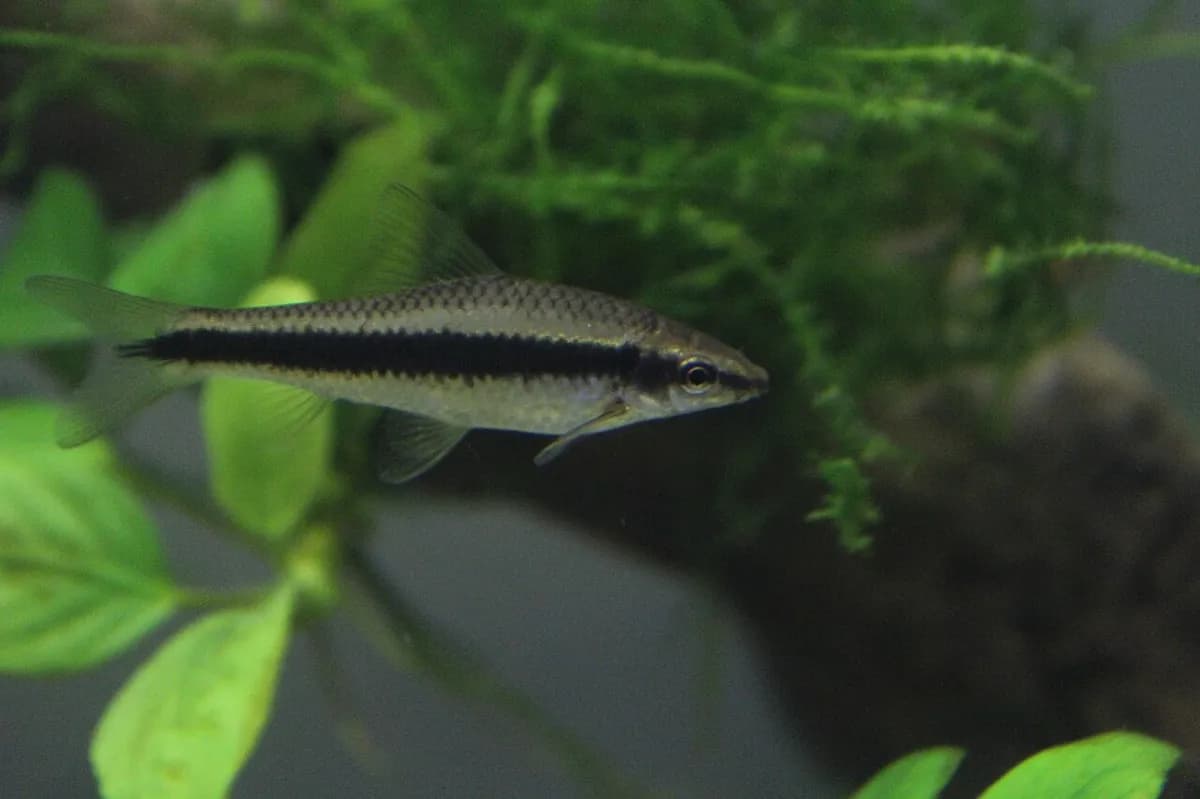
Photo: aleander2137 · CC BY-SA 4.0

husbandry · freshwater
Siamese algae eater vs Chinese algae eater
A true Siamese algae eater has a clean black stripe that runs all the way into the tail fork, tops out around 6 inches, and keeps grazing as an adult. A Chinese algae eater has a sucker mouth, reaches 10 to 11 inches, and often quits algae for the slime coat on slow tankmates. Check the stripe and the mouth before the fish goes home.
By Fishy Dave · Published 2026-10-05
If the stripe runs into the tail and the fish has a normal mouth, you probably have a Siamese algae eater, or SAE. It stays around 6 inches, lives peacefully in a group, and keeps grazing as it grows. If the stripe breaks up into blotches and the fish clamps onto the glass with a round sucker mouth, you probably have a Chinese algae eater, or CAE. It reaches 10 to 11 inches, often stops eating algae, and can start feeding on the slime coat of slow tankmates.
More than once I have carried home a bag labeled "algae eater" and met a different fish a few months later. The checks below take about a minute at the store tank.
Quick ID at the store tank
Start with the stripe. On a true SAE, one black stripe runs from the snout, through the eye, and all the way into the fork of the tail. The upper edge of the stripe looks a little ragged. On a CAE the dark markings are a broken line or a row of blotches, and the gold or albino CAE sold in many stores has no stripe at all.
Then check the mouth. An SAE has a small downturned mouth for scraping. A CAE has a round sucker disc and an extra slit above each gill cover so it can breathe while stuck to a surface. If it hangs on the glass by its lips for long stretches, that is a CAE habit.
Body shape and behavior help too. SAEs are slim, torpedo-shaped, and swim in open water between grazing sessions. They rest on leaves and wood with their fins propped. CAEs are stockier, sit on the glass and rocks more, and tend to chase other fish away from their spot as they grow.
Siamese algae eater care in short
Adult size is about 5 to 6 inches. One SAE needs a 30-gallon tank, and a group of three is happier in 40 to 55 gallons with open swimming room. Keep the water about 75 to 79°F with a pH around 6.5 to 7.5. They jump, so use a tight lid.
SAEs graze hair algae, biofilm, and often black beard algae, especially while young. Feed lightly so they keep working. A few sinking wafers plus blanched zucchini or spinach a couple of times a week is enough. A fat, well-fed SAE grazes less.
They are peaceful with community fish, though two SAEs can squabble at feeding time. A group of three or more spreads that out. Good tankmates include tetras, rasboras, gouramis, and cories in a properly sized tank. The Siamese algae eater care page has the full tank, food, and tank mate notes.
Why the Chinese algae eater is a poor community pick
CAEs are sold small and cheap, and young ones do clean glass. The trouble starts as they grow. Adults reach 10 to 11 inches, become territorial, and many switch from algae to the slime coat of slow, flat-sided fish. Angelfish, discus, and goldfish are the usual targets, and the result is round sores and fish that hide.
If you keep one, plan on a 55-gallon or larger tank, fast and sturdy tankmates like larger barbs or danios, and plenty of rock and wood for it to claim. Feed sinking wafers and some meaty food so it is not hungry. Do not buy one for a 20-gallon community, a goldfish tank, or an angelfish tank.
Look-alikes sold under the same name
The flying fox, Epalzeorhynchos kalopterus, and a few other Crossocheilus and Garra species get sold as "Siamese algae eater" too. The flying fox has a thin gold line above the black stripe, fins edged in red or yellow, and a stripe that stops at the base of the tail. It is also more territorial and does not graze black beard the same way. If the stripe stops short of the tail fork, keep looking.
Safer algae help for small tanks
For a 10 or 20-gallon community, skip both fish and use smaller grazers. Otocinclus work biofilm and soft algae in a school of six in a mature 20-gallon. Nerite snails handle green spot and film on glass and decor. Amano shrimp pick at hair algae. A bristlenose pleco needs about 29 to 30 gallons for one adult.
No fish fixes algae on its own. Cut the light to 6 to 8 hours, feed less, keep up weekly water changes, and scrape the glass. The algae guide walks through each type.
Frequently asked questions
Is a Siamese algae eater the same as a Chinese algae eater?+
No. The Siamese algae eater is Crossocheilus oblongus, often sold under the older name C. siamensis. It is a slim barb relative that stays around 6 inches. The Chinese algae eater is Gyrinocheilus aymonieri, from a different family, with a sucker mouth and an adult size of 10 to 11 inches. Stores mix up the names and the tanks all the time.
How do I tell a Siamese algae eater apart in the store?+
Look at the tail. On a true SAE the black stripe runs straight through the body and into the fork of the tail. Then look at the mouth. An SAE has a normal downturned mouth, not a round sucker disc. If the stripe is broken into blotches or the fish is stuck flat to the glass by its lips, it is probably a Chinese algae eater.
How big do Siamese algae eaters get?+
About 5 to 6 inches as adults. They are sold at 1.5 to 2 inches, so the fish you bring home will roughly triple in length. Plan the tank for the adult.
Can a Siamese algae eater live in a 20 gallon tank?+
As a juvenile for a while, yes. As an adult, no. A 6-inch fish that swims fast laps needs a 30-gallon tank for one, and 40 to 55 gallons for a group of three. A 20-gallon community is better served by otocinclus, nerites, or amano shrimp.
Do Siamese algae eaters eat black beard algae?+
Young ones often do, which is why they get recommended. Adults that get fed a lot of flakes and wafers tend to graze less. Feed lightly, and still fix the light hours, CO2 swings, and old water that let black beard spread in the first place.
Do Chinese algae eaters attack other fish?+
Adults commonly do. As they grow, many lose interest in algae and start latching onto flat-sided or slow fish like angelfish, discus, and goldfish to rasp at their slime coat. That leaves round sores and stressed tankmates. Juveniles look harmless, which is how they end up in community tanks.
What should I do if I already bought a Chinese algae eater?+
Watch it closely around slow, flat-bodied fish and separate it at the first sign of latching. If you cannot give it a 55-gallon or larger tank with fast, sturdy tankmates, ask the store about a return or credit, or rehome it to someone with a big tank. Never release it outdoors.