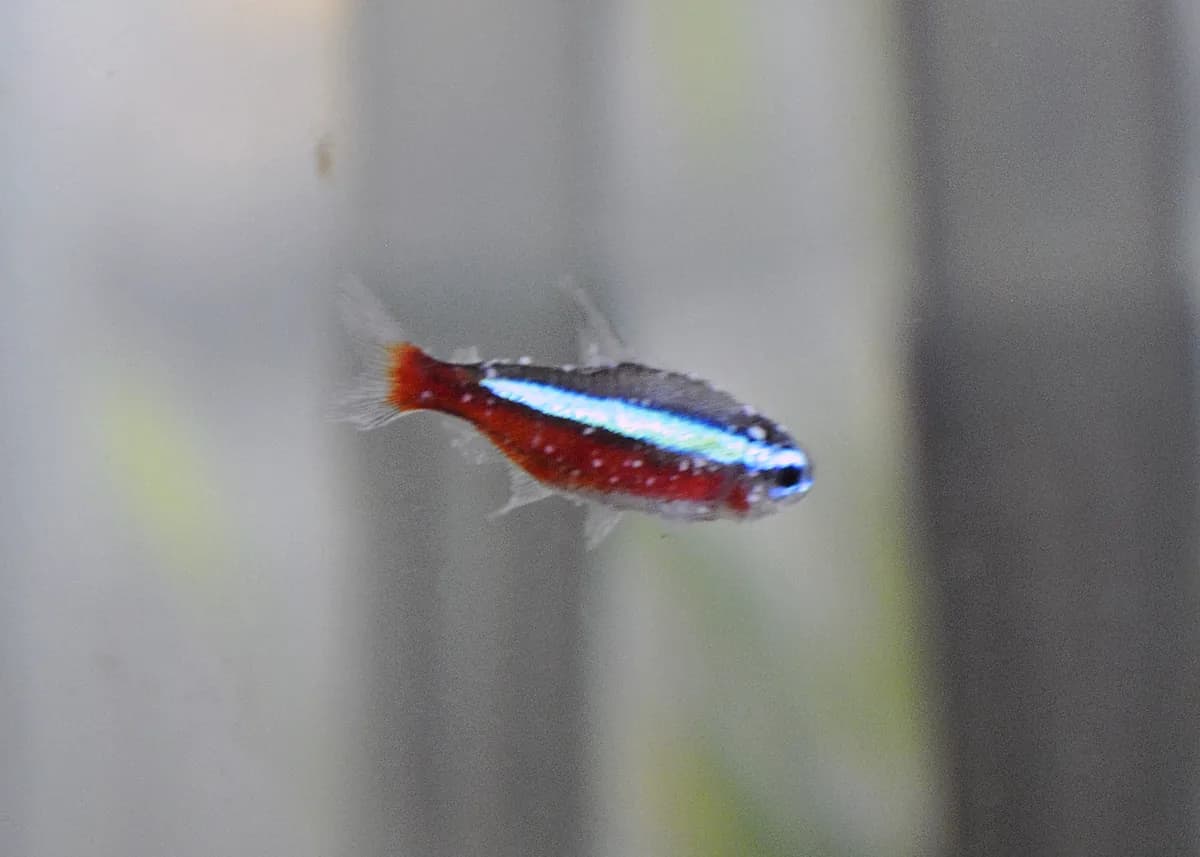
Photo: D. Herdemerten (Hannibal21) · CC BY 3.0

husbandry · freshwater
How to treat ich (white spot) in a freshwater tank
Freshwater ich is Ichthyophthirius multifiliis. Only the free-swimming stage is treatable. Confirm the spots, remove carbon, follow one bottle, and finish days after the last spot.
Published 2026-09-03
Name the parasite
Freshwater ich is the protozoan Ichthyophthirius multifiliis. The white spots you see are trophonts under the skin. Those stages are protected. Medication works on free-swimming theronts after the parasite leaves the fish. That is why you finish the course days after the last spot, not the day the tank looks clean.
At typical tropical temperatures the life cycle runs in a few days. Cooler water stretches it. Marine white spot is a different organism (Cryptocaryon). This page is freshwater only.
Confirm it is ich
Classic ich looks like fine salt grains scattered on body and fins. Fish often flash on décor, clamp fins, or breathe hard when gills are involved. Epistylis can look similar but often sits on a wound and looks fluffier. Lymphocystis makes larger cauliflower lumps, usually on fins, and is viral — not an ich bottle problem.
If ammonia or nitrite is up, fix water quality first. Medication on top of a dirty tank is theater. Test, change water if needed, then treat the parasite.
Temperature, meds, and salt
Raise temperature only if the species and oxygen allow it. Bettas tolerate warmth; many tropical community fish sit fine in the upper 70s to low 80s F for treatment. Extra aeration helps because warmer water holds less oxygen. Do not force a coolwater fish or a stressed, gasping tank into a heat experiment. A thermometer beats the heater dial.
Malachite-green or formalin ich medications are the usual path. Remove chemical filtration (carbon, Purigen, and similar) so the med stays in the water. Dose for the actual gallons. Do not mix random bottles. Follow one label to the end, including the days after spots vanish.
Aquarium salt is optional. Some keepers use it as a support; it is hard on scaleless fish (corydoras, many catfish), live plants, and shrimp. Skip salt in a planted community or a cory tank unless you know those livestock tolerate it. Salt is not a reason to skip a labeled medication when the infection is clear.
Practical sequence
1. Test ammonia, nitrite, and nitrate. Correct water quality if needed with a partial water change. 2. Remove carbon and other chemical media. 3. Decide whether a modest temperature bump is safe for your fish; add air if you raise heat. 4. Dose one ich medication per the bottle. 5. Keep up water changes the label allows. 6. Continue several days after the last spot. 7. When you are done, replace chemical media if you use them.
Quarantine new fish when you can so the display tank is not the hospital. If only one fish is sick in a large community, treat the tank anyway — theronts are in the water. Heat-only is not a guarantee. Finish the course.
Gear for treating ich
A few listings we would open for this job. Skip anything you already own that still works.
Aqueon Pro adjustable heater, 100W
Stable heat matters during treatment. Raising temperature only works if the species and oxygen allow it. A reliable adjustable heater is how you hold a target, not a guess.
Use 50W on a 10-gallon. Do not cook a coolwater fish. Extra aeration helps if you raise temperature. Skip a second heater if one unit already holds the number.
See this listingPAIZOO stick-on digital thermometer
You cannot treat by dial alone. Stick-on digital read outside the glass tells you whether the heater is actually holding the temperature you chose.
Place it away from the heater. A clip-on glass thermometer is fine if you already have one.
See this listingAPI Liquid Super Ick Cure, 4 oz
A widely available malachite-green freshwater ich medication. Remove carbon, dose the bottle, and finish the course after the last spot. One product — do not cocktail.
Follow the label for your gallon count. Not a shrimp tank product. Skip this if you already have a malachite-green/formalin ich med in date and are mid-course. This is freshwater ich, not marine Cryptocaryon.
See this listing
Frequently asked questions
What does ich look like?+
Salt-grain white spots on body and fins, often with flashing (rubbing), clamped fins, or rapid breathing. Spots that look fuzzy, large, or only on one wound are often something else.
Can I cure ich with heat alone?+
Not reliably. Raising temperature can speed the life cycle so medication hits more free-swimming theronts, but heat-only is not a promise. Match the species, add aeration, and use a labeled ich medication when spots are real.
How long do I treat?+
Through the free-swimming stages and for several days after the last visible spot. Stopping when the spots disappear is how tanks relapse. Follow the bottle.
Is aquarium salt enough?+
Salt is optional and hard on scaleless fish, plants, and shrimp. It is not a default for every community. Prefer a labeled ich medication and read the salt notes below before you dose NaCl.