
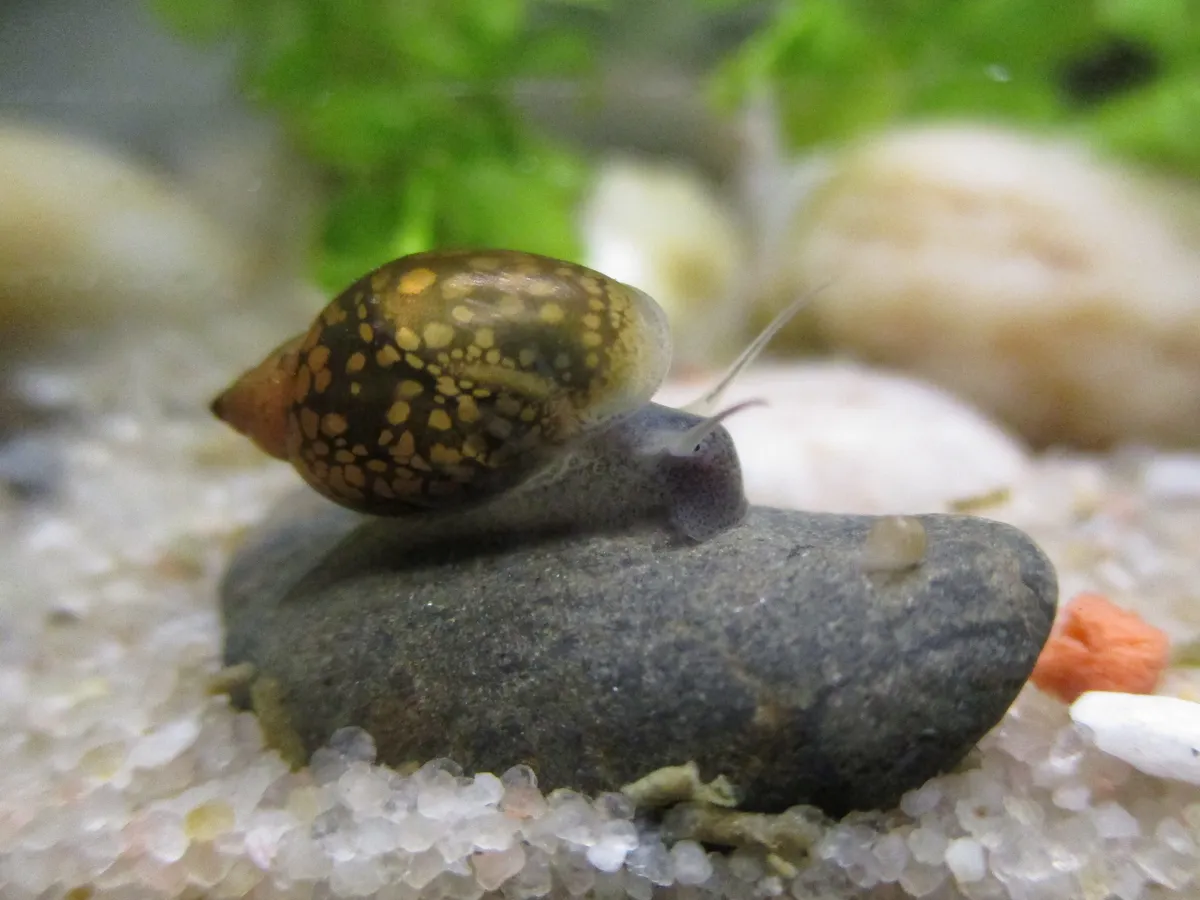
Photo: Dat doris · CC BY-SA 4.0

husbandry · freshwater
How to get rid of pest snails
Bladder, ramshorn, and Malaysian trumpet snails come in on plants and multiply on leftover food. Feed less first, then trap them overnight and pick them off by hand. Assassin snails help over a few months. Copper snail killers also kill shrimp and the snails you wanted.
By Fishy Dave · Published 2026-10-30
Where they come from
Nobody goes to the fish store for bladder snails. They come home as a few eggs on a stem plant or in a clump of moss, and two months later the front glass looks freckled. Live plants bring them into most tanks sooner or later.
A few small snails do no harm. They eat leftover food, algae film, and melting leaves, and Malaysian trumpet snails turn over the top inch of sand. They become a problem when dozens cover the glass every night, when they clog a filter intake or a shrimp tank's sponge, or when you want them gone. Their numbers track how much food the fish leave behind.
Which snail you have
Bladder snails (Physella acuta) have a thin, see-through brown shell up to about half an inch long. Hold one point up with the opening facing you and the opening is on the left. They move fast for a snail and lay clear jelly blobs of eggs on the glass and leaves.
Ramshorn snails have a flat coiled shell, red, pink, or brown, usually under an inch across. They lay flat jelly discs. They eat melting leaves and leftovers and mostly leave healthy plants alone.
Malaysian trumpet snails (Melanoides tuberculata) have a long pointed cone shell with dark flecks, about an inch long. They live in the substrate and come out at night, so a tank can hold hundreds before you notice. They give birth to live young, which means there are no egg clutches to scrape.
A big gold, blue, or ivory snail that lays pink clutches above the waterline is a mystery snail. Its clutches are easy to spot and peel off. Nerite eggs are hard white dots that don't hatch in fresh water. Neither one takes over a tank.
Feed less first
Every pest snail in the tank lives on food the fish missed. Feed what the fish finish in about two minutes, once or twice a day, the same rule as the feeding guide. Drop bottom-feeder wafers after lights out and take out what's left in the morning. Vacuum the gravel at each water change so old food doesn't build up under the surface.
Snail numbers drop on their own once food runs short, but it takes two to three weeks to see. The steps below speed that up.
Trap them overnight
Snails are most active after the lights go off. At bedtime, set half a sinking wafer or a slice of blanched zucchini or lettuce on a saucer or inside a snail trap on the substrate. Blanch vegetables for about a minute in boiling water so they sink. In the morning, before the lights come on, lift it out with the snails on it.
Repeat every night for one to two weeks. A badly overrun tank can give up dozens a night at first. If the morning count keeps falling, the feeding cut is working. Lift the trap first thing in the morning, before snails crawl back out.
Pick them off by hand
Pick snails off the glass with your fingers when you see them. Long tweezers reach the ones on plants and hardscape. Scrape jelly egg clutches off the glass with an algae scraper or a razor blade and net out the bits.
Trumpet snails are the hardest to get to zero because they hide in the sand. Trap at night and vacuum a little deeper at water changes. A few left in a sand bed keep it stirred, so thinning them out is usually enough.
Seal the snails you remove in a bag, freeze it, and put it in the trash. Don't flush live snails or tip them into a pond or creek.
Snail-eating snails and fish
Assassin snails (Anentome helena) eat other snails. They grow to about an inch, have a cone shell with yellow and brown stripes, and leave fish alone. Three to five in a 20 to 30 gallon tank will thin out bladder or ramshorn snails over a few months. They lay one egg at a time, so they don't become the next infestation. They can kill small nerites and young mystery snails, though.
A pea puffer clears snails fast. It also eats shrimp and nips fins, so it belongs in its own tank. Add one only if you were planning a puffer tank anyway, and then the pest snails become free food. Clown loaches are the usual shop suggestion. They grow close to a foot long and live in groups, so they need a much bigger tank than most snail problems come with.
Skip copper snail killers
Many snail-killer products contain copper. It kills every invertebrate in the tank, including cherry shrimp, nerites, and mystery snails, and it can stay in the substrate long after the dose.
A chemical kill also leaves hundreds of dead snails rotting in the gravel at once, which can push ammonia up within a day or two. If you've already dosed one, vacuum the substrate hard, change water, and test ammonia every day for a week.
Keep the next batch out
New plants are the usual way in. A bleach or alum dip and a week or two in a tub catches adults and eggs, and the plant quarantine guide has the times and ratios. Tissue-culture cups arrive snail-free. Pour shop water down the drain, never into the tank, and rinse nets and tweezers between tanks.
Trap, bait, and tweezers
A few listings we would open for this job. Skip anything you already own that still works.
ISTA Snail Trap with bait
A small clear trap with a bait chamber in the middle and a line for pulling it out. Load it at lights-out, lift it in the morning, and empty it into a bag.
Snails crawl back out if it sits too long, so check it every morning. Small shrimp and fry sometimes wander in. Let them out before you empty it.
See this listingHikari Sinking Wafers, 1.76 oz
Bait for the trap or a saucer on the sand. Half a wafer is enough for one night in most tanks. The rest of the bag feeds cories and plecos once the snails are gone.
Pull whatever is left in the morning. A wafer left on the sand all day feeds the snails you are trying to starve.
See this listingStainless aquarium tweezers, about 10 inches
Long tweezers reach snails on plant leaves and in the back corners without your whole arm in the tank. They are the same tool you use to plant stems.
Straight tips grip a snail shell better than curved ones. Rinse them before you move between tanks.
See this listing
Frequently asked questions
Are pest snails bad for my fish?+
A few are harmless. They eat leftover food, algae film, and dead leaves, and they leave healthy fish alone. A big population means too much food is going in. They add waste and can clog a filter intake or sponge.
How long does it take to get rid of pest snails?+
With smaller meals, a trap every night, and hand picking, expect at least three weeks before the glass looks clean. Eggs keep hatching after the adults are gone, so keep trapping for a week past the last snail you see. Assassin snails take a few months to make a dent.
Will assassin snails eat my nerite or mystery snails?+
They can. A full-grown mystery snail is usually too big, but assassins can kill small nerites and young mystery snails. Keep them out of tanks where you want to keep those snails.
Can I use a snail killer in a shrimp tank?+
No. Many snail killers contain copper, which kills cherry shrimp at doses that kill snails. Copper can also stay in the substrate after the dose. Use feeding cuts, traps, and hand removal in a shrimp tank.