
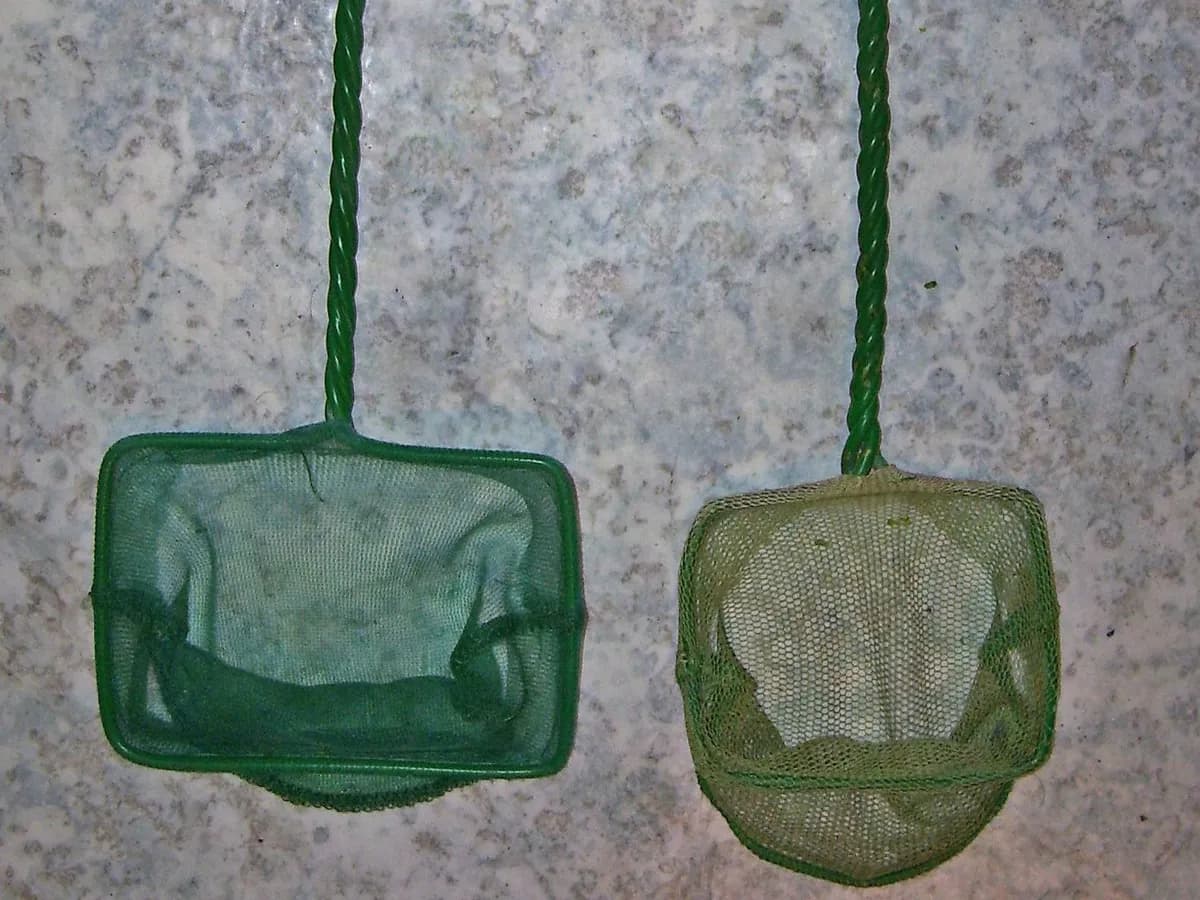
Photo: J C D · Public domain

Gear
Aquarium fish net: mesh, size, and handle length
By Fishy Dave
Pick soft, tight mesh, a net head about twice as wide as the fish is long, and a handle that reaches the gravel. Keep one net per tank, and use a cup instead of mesh for corydoras, plecos, and loaches.
A fish net costs a few dollars, and a bad one costs you torn fins. Coarse mesh snags, and a head that is too small turns a ten-second catch into a ten-minute hunt.
My first catch went the way most first catches go. I chased one tetra around a 20 gallon for twenty minutes, uprooted two plants, and ended up with a wet sleeve and a tank full of fish hiding in the corners. The rest of this page is how to skip that.
Soft, tight mesh
Check the weave before the price. Fine nylon mesh is soft, and the holes are roughly a millimeter across. Coarse knotted mesh has holes big enough for a fin ray or a shrimp's leg to poke through, and a fish that snags will thrash and tear. The photo at the top shows both, with fine mesh on the left and the coarse knotted kind on the right.
Mesh matters most with shrimp and fry. Adult cherry shrimp tangle in coarse mesh, and baby shrimp and livebearer fry go straight through it. If you keep either, buy a net sold for shrimp or fry.
Head size and handle length
Size the head to the fish. A head about twice as wide as the fish is long leaves room for it to swim in without folding in half. A 3 inch head suits shrimp and fish under about 1.5 inches, a 5 inch head suits a betta and most community tetras, and a goldfish or anything over 4 inches wants an 8 to 10 inch head.
Handle length decides how wet your arm gets. A 10 gallon is 12 inches tall, a 20 high is 16, a 29 is 18, and a 55 is 21. The 10 inch handle that comes on most nets reaches the gravel in a 10 gallon, wets your sleeve in a 29, and falls short in a 55. Measure from the rim to the substrate. The handle plus the net head should be longer than that, with room for your hand above the water.
Catching a fish without the chase
Take out the plants and decor the fish can wedge itself behind before you start. Use a second hand, a cup, or a second net to steer the fish toward a corner, and hold the net still in the water so the fish swims into it. Swinging at a fish just sends it to the other end of the tank.
Keep the fish in water the whole time. Slide a container under the net or flip the net into a cup, and do not lift the fish into the air. If the fish has not gone in after a few tries, stop, put the net away, and try again an hour later. Fish are easier to net at feeding time, when they come to the surface on their own.
Spiny fish and bottom dwellers
Peppered corydoras and bristlenose plecos have stiff spines that lock into mesh, and kuhli loaches wriggle into the knots. Use a clear container to herd them, or lift the log or cave they are sitting under and let them swim out into a cup.
If a spine catches in the mesh, do not pull. Keep the net underwater, hold it still, and cut the mesh around the spine with small scissors.
One net per tank
A wet net moves ich, fin rot bacteria, and snail eggs from one tank to the next. The simplest fix is two nets, one that only touches the quarantine tank and one for the display. Label them with a bit of tape.
If a net has to cross tanks, rinse it, soak it for 10 minutes in 1 part plain unscented household bleach to 19 parts water, rinse it well, soak it in conditioned water, and let it dry fully. Do this every time after a tank with ich or fin rot. Replace the net when the mesh frays or the frame rusts, which happens faster in saltwater.
What to buy
The picks below are a 5 inch fine nylon net for most community tanks, a 10 by 7 inch net for goldfish and tanks of 29 gallons and up, and a search for a shrimp or fry net if you keep those. Most homes need two nets of the same size, one per tank. We may earn a commission if you buy. See the affiliate disclosure.
What we would buy
Marina fine nylon net, 5 inch head, 10 inch handle
A 5 inch soft nylon head with a plastic-coated handle. It suits bettas, tetras, rasboras, and livebearers in anything from a 10 to a 29 gallon, and it is a good first net for a quarantine tank.
The 10 inch handle gets your sleeve wet in a tank taller than a 20 high. Marina also sells the same net with a 3 inch head for a 5 gallon betta or shrimp tank. The mesh is fine for fish, but a baby shrimp can still slip through, so see the third pick for those.
See this listingPenn-Plax Quick-Net, 10 x 7 inch head, 10 inch handle
A big head for goldfish, angelfish, and bigger community fish in a 29 gallon or larger. The wide head scoops a fish without needing a perfect aim, and the braided handle keeps its shape.
The handle is the same 10 inches as the small nets, so on a tank taller than 18 inches your arm goes in the water. Do not buy this size for a nano tank, because it is clumsy around plants and hardscape.
See this listingFine mesh shrimp or fry net
A shrimp net has a tighter weave than a standard fish net, so adult cherry shrimp do not tangle and young shrimp and fry do not slip through. The head is usually around 3 inches.
Search for a net sold as a shrimp or fry net, and check that the listing says fine mesh. If you only keep fish, the 5 inch Marina is enough.
See this listing
Frequently asked questions
What size aquarium net do I need?+
Match the head to the fish. A head about twice as wide as the fish is long leaves room for it to swim in without folding. That means a 3 inch head for shrimp and fish under about 1.5 inches, a 5 inch head for bettas, most tetras, and livebearers, and an 8 to 10 inch head for goldfish, angelfish, and anything over 4 inches. If you can only own one, a 5 inch net handles most community tanks.
How long should the handle be?+
Long enough to reach the substrate with your hand above the waterline. A 10 gallon is 12 inches tall, a 20 high is 16, a 29 is 18, and a 55 is 21. The 10 inch handle on most nets works in a 10 gallon, gets your sleeve wet in a 29, and is too short for a 55. For deeper tanks, look for a 12 to 18 inch handle.
Do I need a separate net for each tank?+
Ideally yes, and at minimum one for the quarantine tank that never touches the display. A wet net carries ich, fin rot bacteria, and snail eggs from one tank to the next. If you share a net, soak it for 10 minutes in 1 part plain unscented household bleach to 19 parts water after every use, rinse it well, soak it in conditioned water, and let it dry fully before it goes back in a tank.
Can I net a corydoras, a pleco, or a loach?+
You can, but a cup is better. Corydoras and plecos have stiff spines that lock into mesh, and kuhli loaches wriggle into it. Herd them into a clear container, or lift the decor they are hiding under. If a spine does catch, keep the net in the water, hold it still, and cut the mesh free with scissors instead of pulling.