Skip to content
Swimming FishiesSwimming Fishies
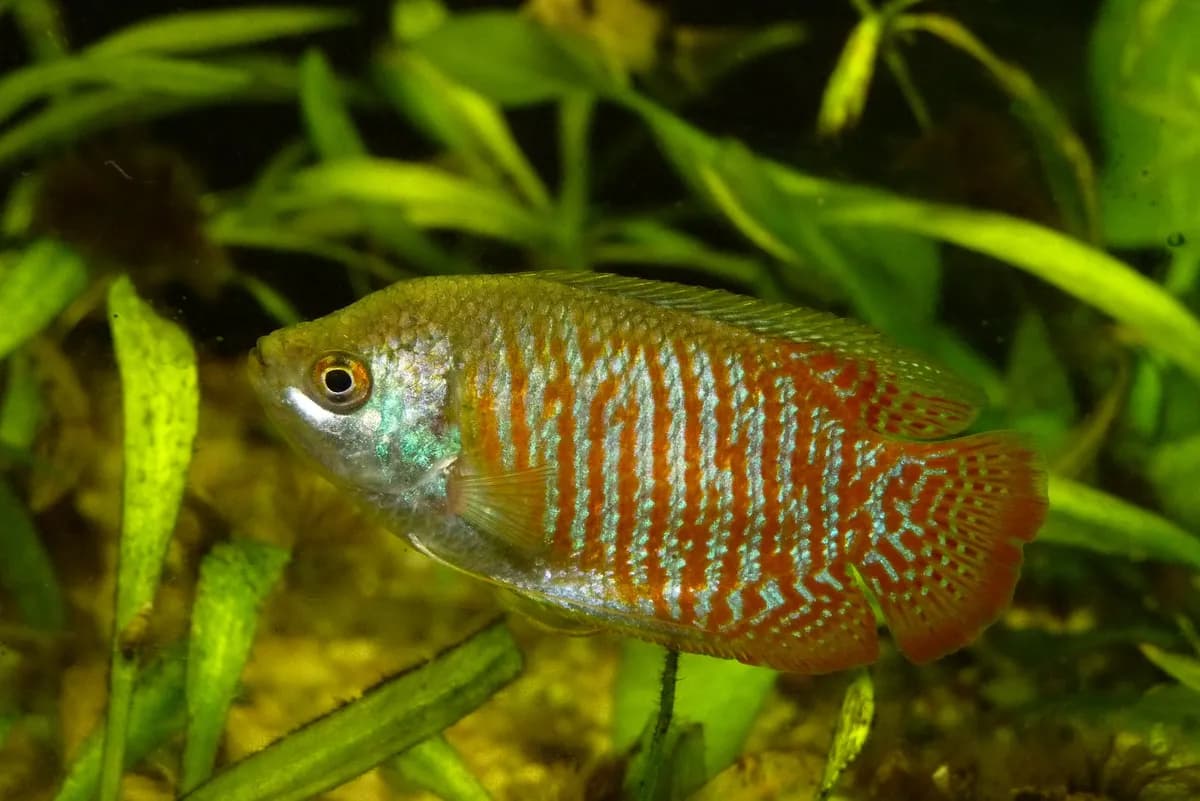
Male dwarf gourami (Trichogaster lalius) with red-orange and pale blue bars swimming among aquarium plants

Photo: JanRehschuh · CC BY-SA 3.0

Freshwater · Beginner · 10+ gal

Dwarf gourami

Trichogaster lalius

By

Dwarf gouramis (Trichogaster lalius) grow to about 3 to 3.5 inches and are the most common gourami in shops. One male fits a cycled 10-gallon, and a 20 gives him room for a school or two females. Keep them at 75 to 80°F with floating plants and gentle flow. Farmed fish often carry dwarf gourami iridovirus, so buy carefully and quarantine.

More freshwater care · Full directory

Care parameters for Dwarf gourami
Water typeFreshwater
Care levelBeginner
Minimum tank10 gallons
TemperamentPeaceful with small community fish, touchy with its own kind. Keep one male per tank. Two males in a 20 usually means one chasing the other until it hides or dies. A male with two females works in a planted 20 long. Do not keep with bettas.
DietOmnivore that feeds near the surface. Micro pellets or flake once or twice a day, plus frozen daphnia, brine shrimp, or bloodworms a few times a week. Feed what they finish in about two minutes.
Temperature72–82 °F
pH6–7.5
Hardness / salinitySoft to moderately hard. Farm-raised dwarfs handle most tap water if it stays stable. Clean water and steady temperature matter more here than an exact hardness number.

Red bars, blue bars, and a lot of color morphs

The dwarf gourami is one of the brightest fish in the store, and the males are territorial, so keep only one male per tank.

Trichogaster lalius, sold for years as Colisa lalia, comes from slow, weedy water in the Ganges and Brahmaputra basins of India and Bangladesh: ditches, ponds, and flooded rice fields. Adult males reach about 3 to 3.5 inches. Females stay a little smaller. With good care they live around four years.

Wild-type males have slanted red-orange bars over a pale blue body, as in the photo above. Farms have bred that into powder blue, cobalt blue, neon blue, and flame or sunset red fish. Females are silver-gray with faint bars and a rounded dorsal fin, and shops rarely stock them, so most tanks end up with a lone male. A male's dorsal fin is longer and comes to a point.

A 10 for one male, a 20 for company

One male dwarf gourami fits a cycled 10-gallon. On his own he is fine, and the calculator also passes him with a group of eight pygmy cories on sand. Finish the cycle before he goes in.

A 20-gallon is where he looks best. One male with eight harlequin rasboras and eight pygmy cories fits a 20 by the calculator's waste math. A male with two females works in a planted 20 long if the plants break up his view so he cannot chase one female all day. Two males need a 40 or more and a lot of plants, and even then it often ends with one hiding. The 20-gallon stocking guide has more mixes, and you can check your own in the stocking calculator.

Floating plants, warm air, and slow water

Dwarf gouramis are labyrinth fish. They gulp air at the surface as well as breathing through their gills, so keep the top open enough for them to reach and the air above it warm. A lid with the water an inch below it holds that air near tank temperature and stops the odd jump.

Set the heater around 77°F. They take 72 to 82°F and pH 6.0 to 7.5. A 50W heater covers a 10, and a 100W covers a 20 long in most rooms. Keep the flow gentle: a sponge filter, or a hang-on-back turned down so the surface ripples without churning.

Floating plants such as red root floaters or frogbit give them shade and the cover they want, and a low-tech planted tank with stem plants gives females somewhere to go. A male may build a bubble nest under the floaters and weave bits of plant into it. That means he is settled.

Iridovirus and how to buy a healthy one

Dwarf gourami iridovirus (DGIV) shows up again and again in farm-raised dwarfs. It has no treatment, and a fish that gets sick from it usually dies. Signs are a fish that stops eating, hangs near the bottom or in a corner, loses or darkens its color, and sometimes develops a swollen belly or open sores. Plenty of dwarfs never show it, but you cannot tell a carrier by looking.

You can improve the odds. Buy from a tank where every dwarf is eating and swimming, with no dead or listless fish in it. Ask the store to feed them while you watch. Skip fish with a sunken or swollen belly, clamped fins, or patchy color. A local breeder's fish are a better bet than a big shipment. Then run a four-week quarantine in a separate tank before the gourami joins anything else.

If you want the look with less risk, a honey gourami is smaller and calmer, and a pearl gourami is bigger and hardier. Neither has the same virus reputation.

Food and tank mates

Feed micro pellets or flake once or twice a day, and frozen daphnia, brine shrimp, or bloodworms a few times a week. They eat at the surface and in the upper water, so in a tank with fast tetras drop a second pinch at the other end. The feeding guide covers amounts.

Good company is small and calm: harlequin rasboras, ember or neon tetras, pygmy or peppered cories, kuhli loaches, otocinclus, and nerite snails. Skip bettas, which fight them for the surface, and tiger barbs, which go after the long feelers. Skip a second gourami of any kind in a tank under 29 gallons. Cherry shrimp are a gamble, because a dwarf gourami eats the babies and sometimes picks at the adults.

Tank mates

  • Harlequin rasboras, ember tetras, or neon tetras as the midwater school
  • Pygmy cories in a 10 or 20, peppered cories in a 20 or bigger
  • Kuhli loaches or otocinclus in a planted tank
  • Nerite snails
  • Skip bettas, tiger barbs, other male dwarf gouramis, and any second gourami in a tank under 29 gallons

Gear for this fish

A few listings we would open for this species. Skip anything you already own that still works.

  • Aqueon Pro adjustable heater, 100W

    Holds a 20 long near 77°F in a normal room, the middle of the range dwarf gouramis like.

    For a 10-gallon, pick the 50W size. Put a separate thermometer at the far end of the tank to check the dial.

    See this listing
  • hygger sponge filter, small

    Gentle, air-driven flow that leaves the surface calm enough for a bubble nest, in a 10 or a 20.

    Needs an air pump and airline. Squeeze the sponge in old tank water during a water change, never under the tap.

    See this listing
  • Red root floaters, live

    Small floating leaves that shade the surface and give a male somewhere to build his nest.

    Quarantine new plants before they go in the tank, and thin them when they cover more than half the surface.

    See this listing

Frequently asked questions

What size tank does a dwarf gourami need?+

A cycled 10-gallon for one male. A 20 for one male with a school of small fish, or a male with two females in a planted 20 long.

Can you keep two male dwarf gouramis together?+

Not in a 10 or a 20. Males fight, and the loser hides and stops eating. Two males need a 40 or larger with dense plants, and it still often fails.

Can a dwarf gourami live with a betta?+

No. Both are labyrinth fish that claim the surface, and they fight. Keep them in separate tanks.

What is dwarf gourami iridovirus?+

A virus common in farm-raised dwarf gouramis. It has no treatment and sick fish usually die. Buy from a tank of healthy, eating fish and quarantine new dwarfs for four weeks.

How do you tell a male dwarf gourami from a female?+

Males are brightly barred red and blue, or a solid farm color like powder blue, with a long, pointed dorsal fin. Females are silver-gray with faint bars and a rounded dorsal.

Next step

Planning a tank for these?

Plan on 10 gallons or more. Put your actual tank size into the stocking calculator and it shows what else can live alongside them.

Open the stocking calculator

Before you buy

Keep your fishies swimming.

Related species

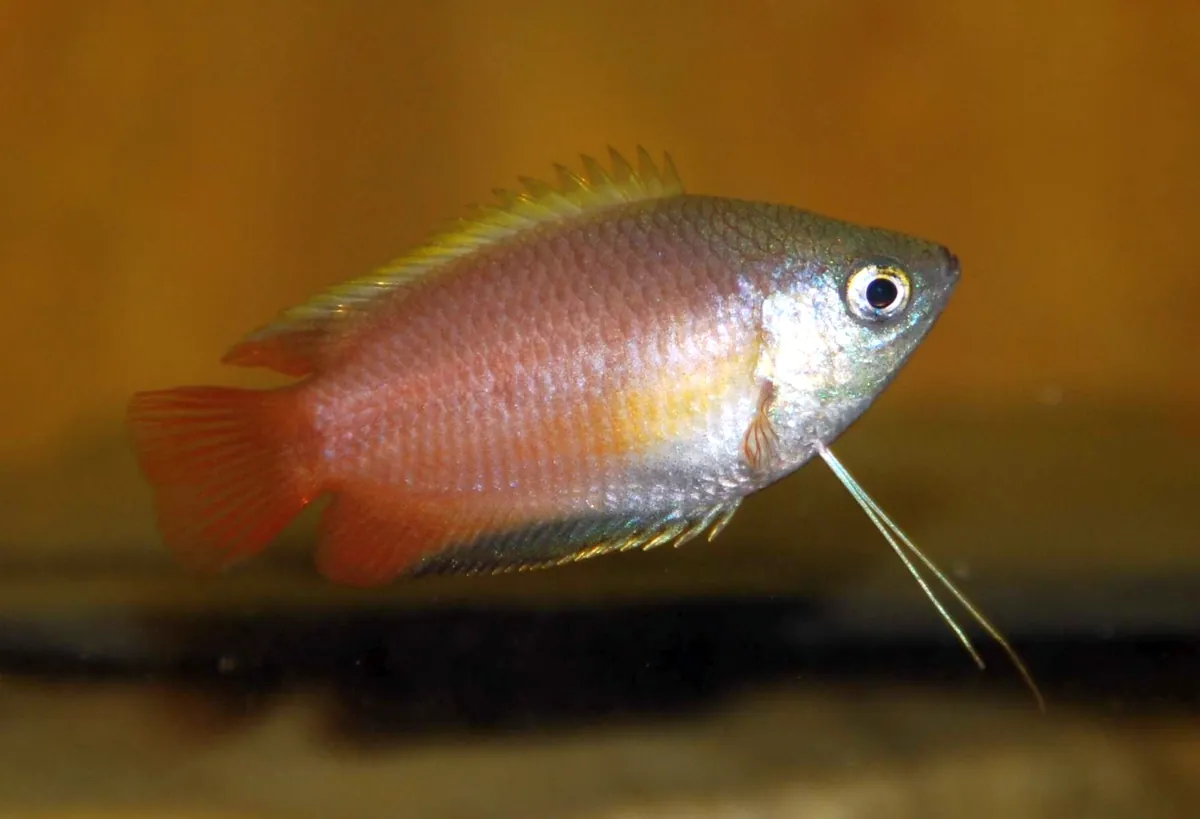
Male honey gourami (Trichogaster chuna) showing amber body color in a planted aquarium

Freshwater · Beginner

Honey gourami

Trichogaster chuna

Honey gouramis (Trichogaster chuna) are small, peaceful labyrinth fish for a planted 10-gallon solo or a 20-gallon pair or community. They are not dwarf gouramis. Shops often mislabel orange dwarfs as honey.

Min. tank: 10 gal

Care notes →
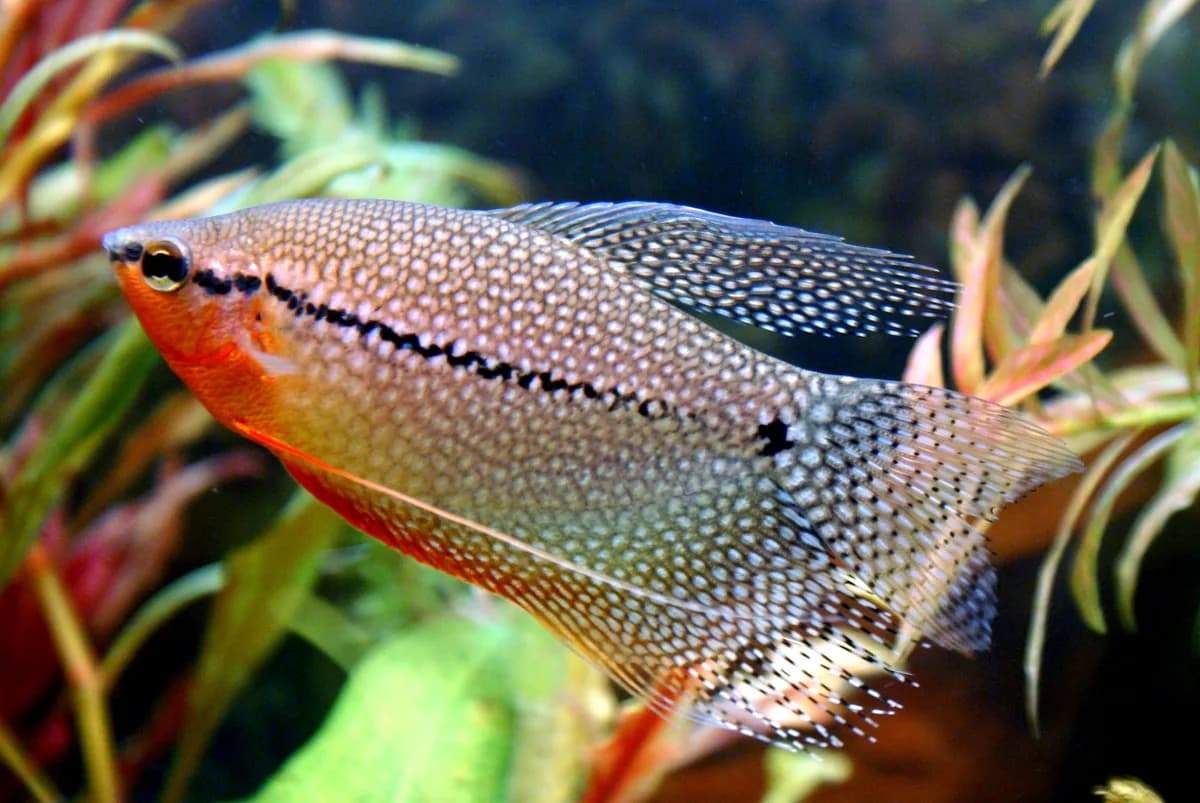
Male pearl gourami (Trichopodus leerii) with pearly spots, a dark side stripe, and an orange throat in a planted aquarium

Freshwater · Beginner

Pearl gourami

Trichopodus leerii

Pearl gouramis (Trichopodus leerii) grow to about 4 to 5 inches and are calm enough to be the centerpiece of a community tank. Keep one in a cycled 20-gallon long, or a pair or one gourami plus a school in a 29. They want warm water at 77 to 82°F, floating plants, gentle flow, and a lid that keeps the air above the water warm.

Min. tank: 20 gal

Care notes →
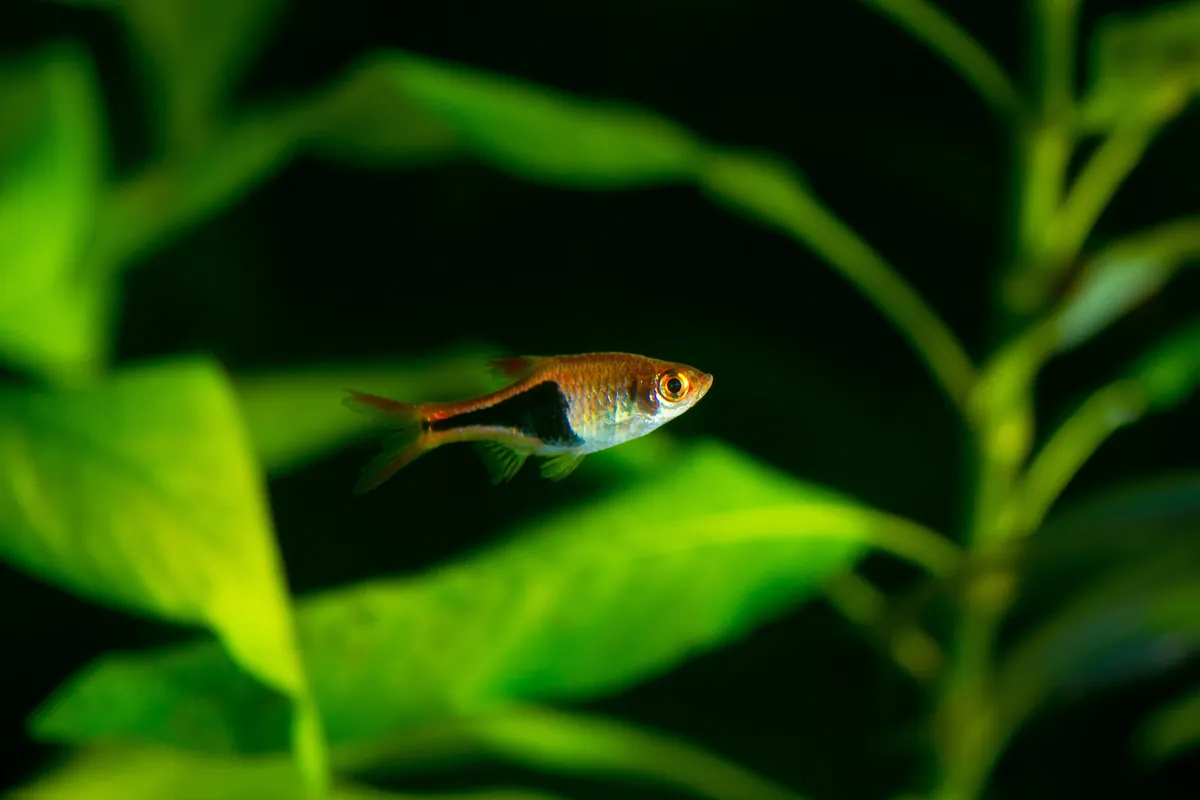
Male harlequin rasbora (Trigonostigma heteromorpha) showing the black triangular patch on the rear body

Freshwater · Beginner

Harlequin rasbora

Trigonostigma heteromorpha

Harlequin rasboras (Trigonostigma heteromorpha) are peaceful midwater schoolers with a black triangle on the rear body. Plan six to ten in a planted 20-gallon; a 10 is a tight floor for six, not a comfortable home.

Min. tank: 20 gal

Care notes →