
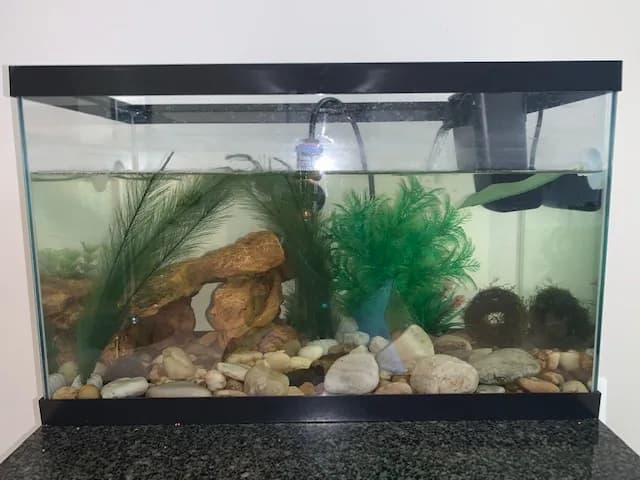
Photo: Jomeliegill · CC BY-SA 4.0

husbandry · freshwater
New tank syndrome: what to do when fish are dying in a new tank
Fish dying in the first few weeks usually means ammonia or nitrite from a tank that has not cycled yet. Test today. At 0.25 ppm or more of either, change water, feed less, and test daily until both hold at 0.
By Fishy Dave · Published 2026-10-08
The tank looked great on Saturday. By Wednesday the tetras are hanging at the surface and you are reading forums at midnight. The store said to let the water sit for a day. The store also sold you the fish.
This happens often enough to have a name, and most of it is fixable today. If you have no fish yet and want to know how to cycle a tank, read how to cycle a fish tank instead. This page is for fish that are already in the water.
What new tank syndrome is
Fish waste and leftover food break down into ammonia. In a cycled tank, bacteria in the filter turn ammonia into nitrite and nitrite into nitrate, which is far less toxic. A new filter has almost none of those bacteria, so ammonia builds up first and nitrite follows.
It usually shows up 3 days to 3 weeks after the first fish go in. It can also hit an older tank after a big batch of new fish, a full filter media swap, or a rinse under the tap.
Symptoms
Fish gasp at the surface or crowd the filter outflow. Gills look red, purple, or swollen. Fins stay clamped, fish sit on the bottom, and they stop eating. Tan or brown gills can point to nitrite. Deaths tend to come one at a time over several days.
These signs overlap with disease, so test the water before you reach for medication. Many medications, antibiotics in particular, also knock back the filter bacteria you are trying to grow.
What the test readings mean
If ammonia and nitrite both read 0 and nitrate is present, the tank has cycled. Look at something else: temperature, untreated tap water, disease, or a bully.
At 0.25 ppm ammonia, change about 30% of the water today and test again tomorrow. At 0.5 to 1 ppm, change 50% today and test again in 12 to 24 hours. Above 1 ppm, change 50% now and another 50% later the same day or first thing tomorrow. Keep going until it reads 0.25 or less.
Use the same numbers for nitrite. Nitrite above 0.5 ppm is hard on fish, and above 1 ppm it can kill within a day or two.
Below pH 7, more of the ammonia sits in the less toxic ammonium form. That buys a little time. It is not a reason to skip the change. Nitrate above 40 ppm is not an emergency, but it means water changes are overdue.
What to do today
Test ammonia, nitrite, and nitrate before anything else. Write the numbers down with the date. You will want them next week.
Change water based on the readings above. Match the temperature within a couple of degrees and treat the new water with a conditioner that handles chloramine. Two 50% changes a few hours apart are easier on fish than one 90% change.
Feed a small pinch every other day until ammonia and nitrite hold at 0, and net out anything left after two minutes. Healthy adult fish get through a week of light meals without trouble.
Do the water change first, then dose a live nitrifying bacteria product at the label rate. Some bottles say to skip water changes for a week afterward. If ammonia or nitrite climbs past 0.5 ppm anyway, change the water. The fish come first.
Leave the filter alone. Do not rinse the media under the tap and do not swap the cartridge, because that is where the bacteria live. If it clogs, swish the media in a bucket of the tank water you just took out.
Add air. An air stone, or a water line low enough that the filter outflow splashes, helps fish with damaged gills. Add no new fish until the readings settle.
The next few weeks
Ammonia usually peaks in the first week or two. Nitrite rises as ammonia falls and often hangs on longer. Test every day while either reads above 0, then every other day.
A fish-in cycle usually takes 4 to 8 weeks. You are done when ammonia and nitrite read 0 for a full week at normal feeding and nitrate is creeping up. Then switch to a weekly 25 to 30% water change and add new fish a few at a time.
Used filter media from a friend's healthy tank speeds this up more than any bottle. Squeeze it into your filter or tuck it behind the sponge. A milky haze in the first week is usually a bacterial bloom; see cloudy aquarium water before you change water for that alone.
What helps during a spike
A few listings we would open for this job. Skip anything you already own that still works.
API Freshwater Master Test Kit
You need ammonia, nitrite, and nitrate numbers to know how much water to change and when to stop. Liquid tests are easier to read at 0.25 ppm than most strips.
Freshwater only. If the bottles you already own are in date, you do not need another kit.
See this listingSeachem Prime, 500 ml
Dechlorinates the new water for every change and binds some ammonia and nitrite for about a day between changes. It buys time. It does not replace the water change.
Skip it if you already use a chloramine-capable conditioner. Most liquid ammonia tests still read ammonia that Prime has bound.
See this listingTetra SafeStart Plus
Live nitrifying bacteria can shorten a fish-in cycle when the filter is running and the bottle is in date. Dose it after the water change.
Skip it if a friend can give you used filter media from a healthy tank. That works better than any bottle.
See this listing
Frequently asked questions
Why are my fish dying in a new tank?+
Usually ammonia or nitrite. A new filter has not grown enough bacteria to break down fish waste, so it builds up in the water. Test both. Any reading above 0 with fish in the tank calls for a water change.
How much water should I change for an ammonia spike?+
About 30% at 0.25 ppm and 50% at 0.5 ppm or more. Above 1 ppm, do two 50% changes a few hours apart. Match the temperature and dechlorinate the new water.
Does bottled bacteria fix new tank syndrome?+
Live nitrifying bacteria can shorten the wait if the filter is running. It does not remove the ammonia already in the water, so keep testing and changing water.
Should I stop feeding my fish during a spike?+
Cut back, but do not starve them. A small pinch every other day is enough for healthy adult fish while ammonia or nitrite reads above 0.
How long does new tank syndrome last?+
Usually 4 to 8 weeks with fish in the tank. It is over when ammonia and nitrite read 0 for a week at normal feeding and nitrate is rising.