Photo: Russel Leidich · CC BY 3.0

husbandry · freshwater
Cloudy aquarium water: bloom, dust, or algae
Milky new-tank bloom, scaping dust, green water, and surface film look similar until you test. Ammonia or nitrite up means protect the fish with a change; clear nitrogen with a bacterial bloom means wait.
Published 2026-09-05
Look first, then test
Cloudy water is a symptom, not a single disease. Four common looks cover most freshwater tanks: milky white bacterial bloom, dusty gray after you move substrate, green water from free-floating algae, and a thin film on the surface. Guessing wrong leads to endless water changes or a rinsed filter that sets the cycle back.
Always test ammonia, nitrite, and nitrate before you act. If ammonia or nitrite is above zero, this is a cycle or filter problem first. Change water to protect the fish, then fix the cause. Clear nitrogen with a white haze is a different job.
Milky white: bacterial bloom
New tanks and freshly restarted filters often go milky for a few days to a couple of weeks. Heterotrophic bacteria bloom when dissolved organics are high and the biofilter is still catching up. The water looks like watered-down milk. Fish may look fine if ammonia and nitrite stay at zero.
Do not water-change on a loop just to chase clarity. Do not rinse filter media under the tap. Leave the filter running, feed lightly, keep testing, and wait if nitrogen is under control. A bloom can return briefly after a big clean or a media swap. Patience beats panic scrubbing.
Dust, green water, and surface film
After you add sand or gravel, or re-scape hard, fine particles hang in the water. That dust usually settles in 24–48 hours if you leave the filter alone and avoid blasting the substrate when you refill. A polishing pad can speed it; a full tear-down does not.
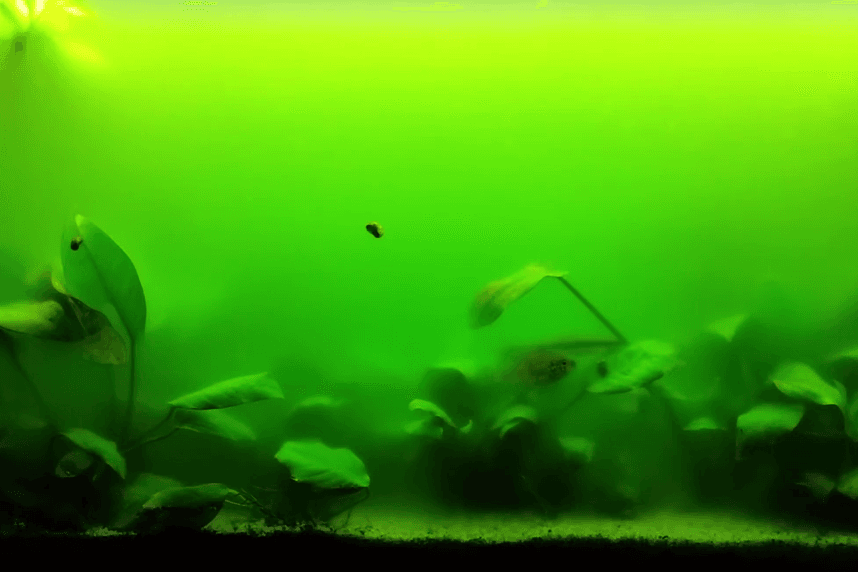
Green water is free-floating algae, not a bacterial milk. It tints the whole column green and often follows too much light, leftover food, or a nutrient surplus. Shorten the photoperiod, stop overfeeding, and keep the usual 25–30% weekly water change on an established tank. UV clarifiers clear stubborn green water once chemistry is stable. Do not bleach the tank.
A rainbow or greasy film on the surface is usually biofilm from organics and still air. A surface skimmer, more surface agitation, and less leftover food fix most cases. Wipe the film with a paper towel if you need a quick reset, then fix the cause.
When you do change water
Elevated ammonia or nitrite means change water now to protect livestock, then find why the cycle slipped: overfeeding, too many fish, rinsed media, or an uncycled tank. Match temperature, use a dechlorinator that handles chloramine, and leave the fish in the tank. The water-change guide covers the 25–30% weekly habit for established communities; that advice still holds when the cloud is gone and the tank is stocked.
Crystal-clear water is not the only goal. Stable parameters and a working biofilter matter more than a showroom photo on day three of a new setup. Test, name the look, and pick the lever that matches: wait, settle, dim the lights, or change water because the numbers say so.
Gear when the water goes cloudy
A few listings we would open for this job. Skip anything you already own that still works.
API Freshwater Master Test Kit
Cloudy water without numbers is a guess. Liquid reagents for ammonia, nitrite, nitrate, and pH tell you whether this is a cycle problem or a harmless bloom.
Freshwater only. Skip strips as your only tool. If the bottles you already own are in date, you do not need another kit.
See this listingSeachem Prime, 500 ml
When ammonia or nitrite is up, you change water to protect the fish. Dose new water with a chloramine-capable conditioner. The bottle is not a substitute for partial changes.
Skip a second bottle if you already use a chloramine-capable conditioner. The sulfur smell is normal.
See this listingPython No Spill Clean and Fill, 25 foot
Useful when tests say you do need water changes: ammonia or nitrite spikes, or the weekly 25–30% on an established tank. Faucet-hookup gravel tube and hose without buckets.
Skip this on a 20 if a siphon and a FISH-only bucket already work. Confirm the brass adapter fits your faucet. Do not use a Python to water-change a harmless bacterial bloom into a loop.
See this listing
Frequently asked questions
Should I keep changing water until the cloud clears?+
Only if ammonia or nitrite is elevated. A milky bacterial bloom with zero ammonia and nitrite usually clears on its own. Changing water on a loop and rinsing the filter under the tap often makes it worse.
Is cloudy water always a bacterial bloom?+
No. Fine dust after scaping settles in a day or two. Green water is free-floating algae. A greasy surface film is biofilm. Look, then test.
Do I bleach the tank to fix cloudiness?+
No. Bleaching an established or cycling tank wipes the bacteria you need and shocks the fish. Diagnose the look, test chemistry, and treat the cause.
How do I clear green water?+
Cut photoperiod (start around 6–8 hours), reduce leftover food and excess nutrients, and keep up normal maintenance. UV clarifiers help stubborn free-floating algae once the tank is otherwise stable. Do not bleach.