
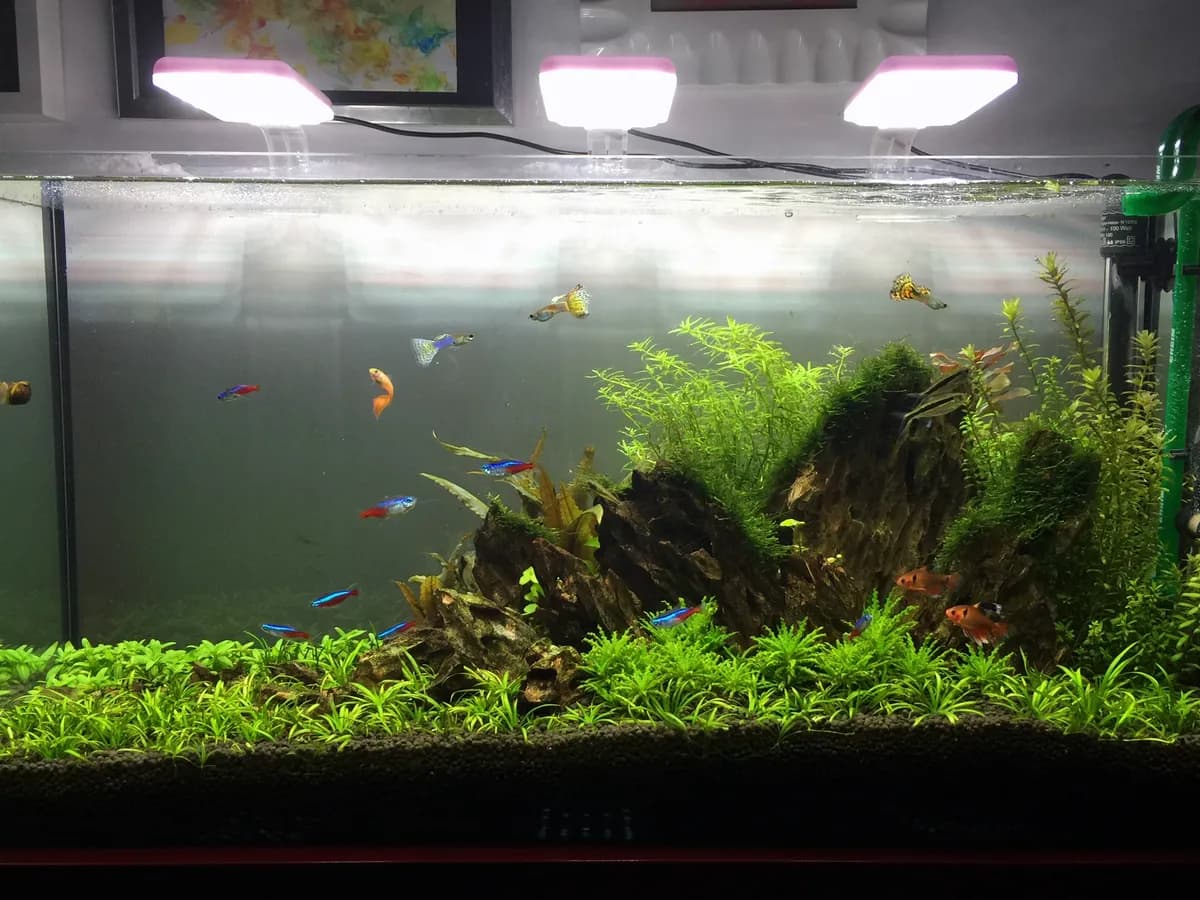
Photo: Gustavo Sivila · CC BY-SA 4.0

Gear
Aquarium light timer
By Fishy Dave
Start a new tank at 6 to 8 hours of light a day and let a timer run it, so the schedule doesn't depend on you remembering. Check whether your light already has a timer built in before you buy one. Then pick a mechanical outlet timer, a digital one, or a smart plug.
Many algae outbreaks start with a light left on too long. A timer costs about what a tub of flakes does and takes the guesswork out.
Plants and fish do better on the same hours every day, and algae takes advantage when the light runs long or the hours wander. A timer keeps the schedule steady whether or not you are home.
How many hours to set
For a new tank, a fish-only community, or a low-tech planted tank, start at 6 to 8 hours a day. That is enough to see the fish in the evening and keep easy plants like anubias, java fern, and crypts growing.
Leave it there for two or three weeks. If plants are putting out new leaves and the glass is staying clean, add an hour and wait another couple of weeks. If green film, hair algae, or green water shows up, cut back an hour before you buy anything for it. The algae guide covers the rest of the fixes, starting with feeding and water changes.
Set the on time for when you are actually around to watch the tank. A block from 2 p.m. to 10 p.m. suits most people who work days. A light that snaps on in a dark room can startle fish into the glass, so set it to come on after the room is already light.
Check the light you already own
Many LED bars sold in the last few years have a timer built in, sometimes with a sunrise and sunset ramp. If yours does, set it to 6 to 8 hours and you are done. Use the shortest preset, not the longest one.
Kit hoods and basic clip-on LEDs usually have only a switch. Those are what an outlet timer is for. If you are shopping for a new light anyway, the aquarium LED light page covers bars for 10- and 20-gallon tanks that come with a timer.
What stays off the timer
Only the light goes on the timer. The filter has to run all the time or the bacteria in it start to die off. The heater has its own thermostat and should stay plugged into a normal outlet. An air pump also stays on around the clock, especially in a tank with a lot of fish.
Plug the timer into a grounded outlet, ideally one with GFCI protection, and loop the light's cord down below the outlet before it comes back up. That dip, called a drip loop, keeps water that runs down the cord from reaching the plug.
Picking between the three
A mechanical timer is the cheapest and does the job. The only real downside is that it loses time when the power goes out. A digital timer costs a few dollars more and keeps its clock through a power cut. A smart plug is worth it if you like to adjust the schedule from your phone, or the outlet is behind a cabinet you'd rather not reach into.
What we would buy
One timer per tank. If the light already has a timer, skip this section. We may earn a commission if you buy. See the affiliate disclosure.
BN-LINK 24-hour mechanical outlet timer
The cheap, simple option. Push down the pins for the hours you want the light on, plug the light into it, and it repeats every day. No app, no menus. Good for a kit hood or a basic LED with only an on/off switch.
A mechanical timer stops when the power is out, so after an outage it runs behind by however long the power was off. Reset the dial afterward. It ticks quietly, which you might notice on a nightstand tank.
See this listingDigital outlet timer with battery backup
Same job as the mechanical timer, set with buttons instead of pins. The backup battery keeps the clock running through a power cut, so the schedule is still right afterward. Many let you set different times for weekdays and weekends, which a tank doesn't need.
Pick one that says it keeps time through outages and has an indoor grounded plug. The buttons are small and the manual is usually worse than the timer. Set the clock first, then the on and off times.
See this listingSmart plug with schedules
Lets you set and change the schedule from a phone app, and turn the light on early when you want to show someone the tank. Useful if the tank sits somewhere awkward to reach.
Look for one that works over your home Wi-Fi without a separate hub, and check what it does after a power cut (some come back on, some come back off). Some keep running the saved schedule when the Wi-Fi drops and some don't, so read the maker's notes before you trust one through a week away.
See this listing
Frequently asked questions
How many hours a day should an aquarium light be on?+
Start at 6 to 8 hours for a new tank, a fish-only community, or a low-tech planted tank. If the plants are growing and algae stays under control after a few weeks, you can add an hour. Most tanks settle somewhere between 6 and 10 hours.
Do fish need darkness at night?+
Yes. Fish rest in the dark, and a light left on all night grows algae while you sleep. Room light from a lamp or a window is fine. The tank light is what goes off.
Should I split the light period with a midday break?+
Most tanks don't need one. A light-off break in the middle of the day is a trick some planted-tank keepers use against algae. In a beginner tank, a shorter single block of light does the same job with less to set up.
Can I put the heater and filter on the same timer?+
No. The filter, heater, and air pump run all day and night. Only the light goes on the timer. If your timer has a second outlet that is always on, leave it empty or label it so nobody plugs the heater into the switched side by mistake.
My LED light has a built-in timer. Do I still need one?+
No. Use the light's own schedule. Putting a programmable LED on an outlet timer can reset its clock or settings every time the power cuts, depending on the model.